
Competitor Proximity Analysis: Map Nearby Rivals Before You Open
Use competitor proximity analysis to map nearby rivals, spot saturated catchments, and find stronger site selection opportunities.
Ahmed
Founder of Locus
The Strategic Value of Knowing Where Your Competitors Are
Competitor proximity analysis is the process of mapping nearby direct and adjacent competitors, then measuring distance, density, catchment overlap, ratings, review volume, and demand indicators around a candidate site. For site selection, those metrics show whether a location is oversupplied, underserved, or strong enough to support another operator.
Choosing where to open a new location is inherently a competitive decision. Every site exists within a landscape of alternatives — other businesses offering similar products or services to the same customer base. Competitor proximity analysis uses geospatial data to map that landscape, revealing where the market is oversaturated, where it is underserved, and where the conditions are right for a new entrant to capture meaningful share.
This is not about copying what competitors do. It is about understanding the spatial distribution of supply relative to demand, and using that understanding to make sharper location decisions.
For a wider site selection workflow, pair this analysis with AI location intelligence, foot traffic analysis, demographic analysis for business location, and competitive catchment analysis.
What Competitor Proximity Analysis Involves
Building a Comprehensive Competitor Map
The first step is assembling an accurate and complete inventory of competitor locations within your target geography. This goes beyond your most obvious direct competitors. Indirect competitors — businesses that serve the same need in a different format — should also be included. A fast-casual restaurant competes not only with other fast-casual concepts but also with quick-service chains, food trucks, and grocery store prepared food sections.
Data sources for competitor mapping include business registries, commercial databases, points-of-interest datasets, and web scraping of directory listings. The goal is a georeferenced dataset that shows every relevant competitor as a point on a map.
Measuring Density and Saturation
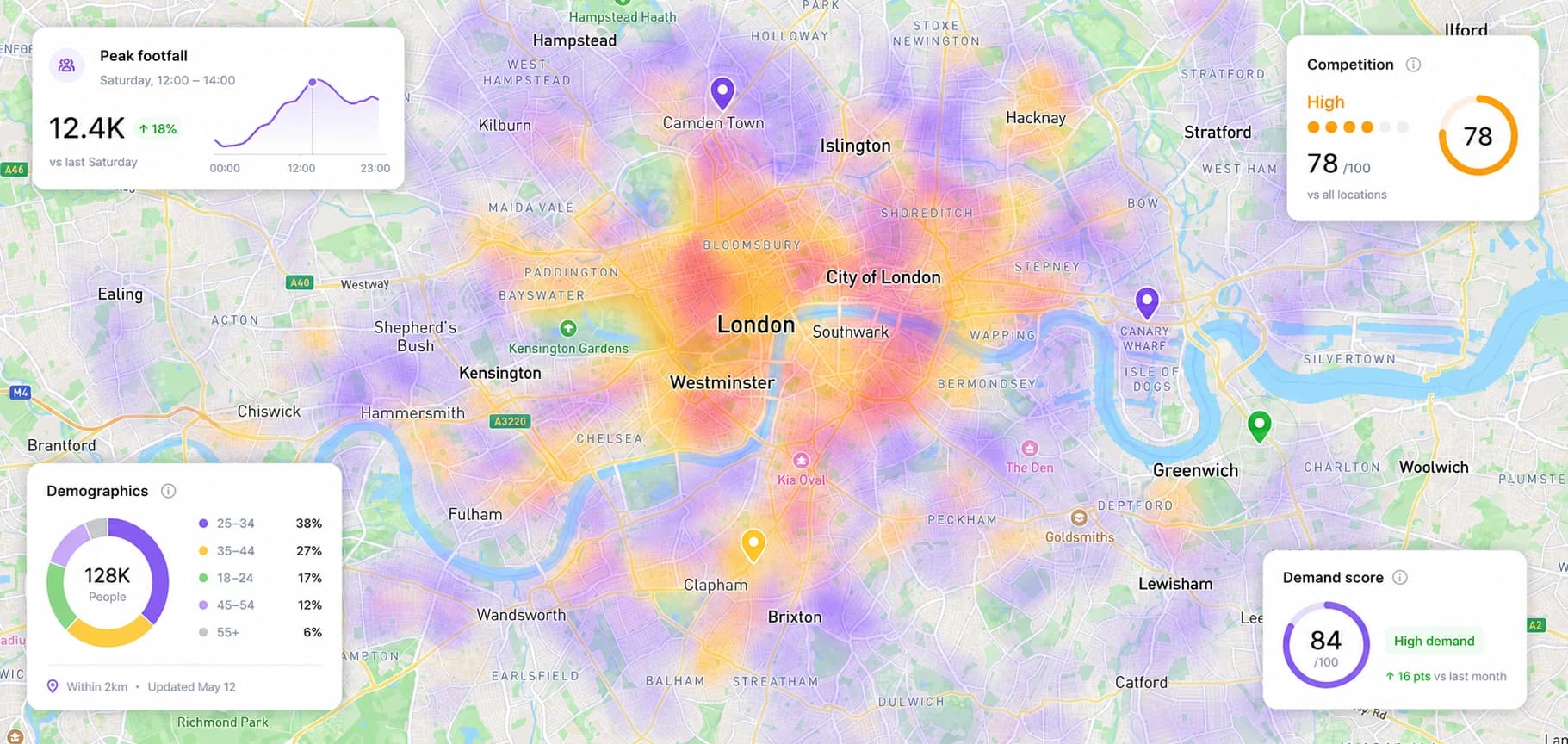
Once competitors are mapped, density analysis reveals where they cluster and where gaps exist. Heatmaps and kernel density estimates provide a visual layer that makes patterns immediately apparent. High-density zones indicate mature, competitive markets. Low-density zones suggest either a lack of demand or an underserved opportunity — a distinction that requires further investigation.
Calculating Proximity Metrics
Beyond density, specific proximity metrics help quantify the competitive environment around a candidate site. Common metrics include the distance to the nearest competitor, the number of competitors within a defined radius, and the average spacing between competitors in a submarket. These numbers become inputs to scoring models that rank candidate locations against each other.
How to Identify Genuine Market Gaps
Not every area with few competitors represents an opportunity. Some areas lack competition because they lack the population density, income levels, or traffic patterns to support a business. The key is distinguishing genuine underserved markets from areas where demand simply does not exist.
Cross-Reference With Demand Indicators
Overlay competitor density with demand-side data: population growth, household income, consumer spending in your category, daytime employment density, and foot traffic volume. An area with low competitor density and strong demand indicators is a high-priority target. An area with low density and weak demand indicators is likely a desert for good reason.
Analyze Competitor Performance Signals
Where possible, gather performance signals from existing competitors in or near the target area. Long wait times, packed parking lots, high online review volumes, and rapid expansion by competing brands all suggest that demand is outpacing supply. These signals validate the market gap identified through spatial analysis.
Evaluate Barriers to Entry
Some markets appear underserved because barriers make them difficult to enter — restrictive zoning, limited available real estate, high construction costs, or complex permitting processes. Understanding these barriers is essential before committing resources to a location that looks promising on a density map but proves impractical to develop.
Strategic Approaches to Competitor Proximity
The Clustering Strategy
In some industries, proximity to competitors is an advantage. Auto dealerships, restaurant rows, and medical office districts all demonstrate clustering effects where a concentration of similar businesses draws more total traffic than any single business could attract alone. If your industry benefits from comparison shopping or agglomeration effects, locating near competitors may increase your visibility and customer flow.
The White Space Strategy
For businesses where convenience and proximity drive customer choice — grocery stores, pharmacies, dry cleaners, fitness studios — finding white space away from competitors is typically the stronger play. Customers in these categories default to the nearest acceptable option, so being the only option within a reasonable travel distance confers a powerful advantage.
The Flanking Strategy
A flanking approach targets areas where competitors are present but positioned to serve a different customer segment. A premium fitness concept might locate near budget gyms, betting that the area contains an underserved segment willing to pay more for a differentiated experience. This strategy requires a clear understanding of competitor positioning and the demographic composition of the trade area.
Building Competitor Analysis Into Your Site Selection Process
Competitor proximity analysis should not be an afterthought or a one-time check. Integrate it into the earliest stages of your site selection workflow as a screening filter. Before investing time and resources in detailed feasibility studies, use competitor mapping to eliminate oversaturated zones and prioritize areas where the competitive math works in your favor.
As your business grows and the competitive landscape shifts — new entrants arrive, existing competitors close or rebrand — update your competitor data regularly. The market gaps of today may be the saturated zones of tomorrow, and the businesses that track these shifts in real time will consistently find better locations than those relying on outdated snapshots.
Existing operators can use the same competitor proximity analysis after launch. Locus Monitor helps teams move from one-off site research into business monitoring, tracking competitor movement, review changes, services, prices, and local market shifts over time.
Turning Competitive Intelligence Into Location Advantage
Competitor proximity analysis transforms publicly available information into strategic advantage. By systematically mapping where competitors operate, measuring the density and spacing of that competition, and cross-referencing with demand data, businesses can identify locations where the odds of success are structurally higher. In a landscape where real estate commitments are long-term and costly, that kind of intelligence is not optional — it is essential.
Keep reading
Related guides from the Locus library.
AI-Powered Location Intelligence for Local Business Growth
How Locus brings competitor mapping, demographics, foot traffic, catchment analysis, local reputation tracking, and AI recommendations into one practical workflow.
How AI is Revolutionizing Location Intelligence for Businesses
Discover how artificial intelligence is transforming business location decisions. Learn about AI-powered site selection, predictive analytics, and automated insights.