
AI-Powered Location Intelligence for Local Business Growth
How Locus brings competitor mapping, demographics, foot traffic, catchment analysis, local reputation tracking, and AI recommendations into one practical workflow.
Sara
Head of Growth
Choosing the right location has always been one of the highest-stakes decisions in business.
For a cafe, gym, restaurant, salon, clinic, retail shop, franchise, or service business, location shapes visibility, customer demand, competition, staffing, pricing, and long-term growth. A site can look perfect from the street and still fail once the demographics, foot traffic, local reputation, or competitor landscape tell a different story.
For years, professional location intelligence belonged mostly to enterprise retailers with the budget for expensive platforms or bespoke research.
Locus was built around a simpler idea: location intelligence should be accessible to the teams that actually need it every day.
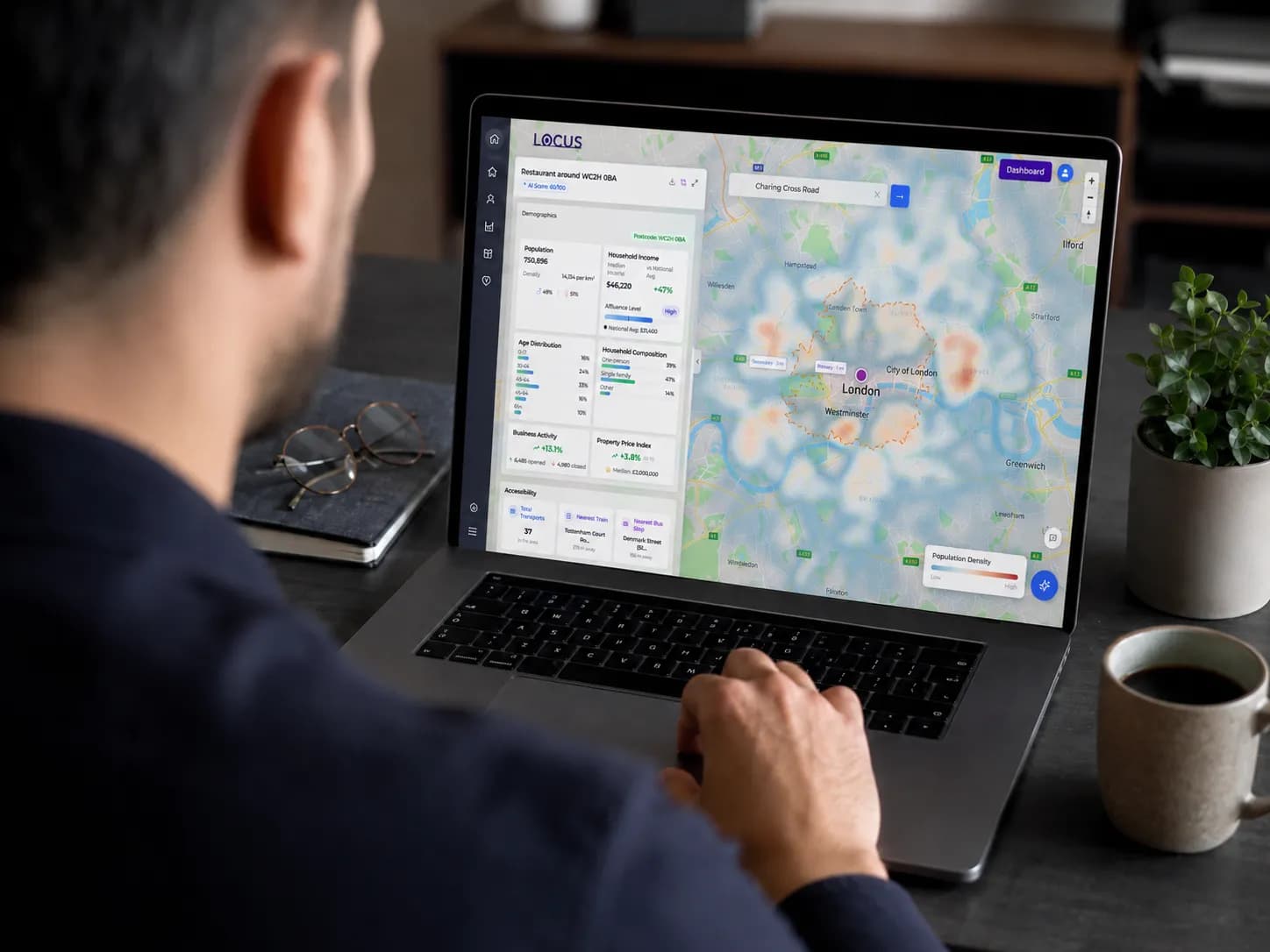
Locus is an AI-powered location intelligence platform that helps founders, commercial real estate agents, franchise operators, SMEs, consultants, and existing business owners understand physical markets more clearly. It combines business location analysis, competitor mapping, demographic analysis, foot traffic insights, catchment analysis, local reputation tracking, and AI-generated recommendations into one practical workflow.
The result is a platform that helps teams answer two essential questions:
Where should we open?
And once open:
How do we win in this neighbourhood?
Why Accessible AI Location Intelligence Changes the Game
Locus emerged from a clear observation: enterprise location intelligence tools are powerful, but often too expensive, complex, or heavyweight for many professional teams.
Franchise operators need to evaluate new territories. Commercial real estate agents need to prove why a unit makes sense for a tenant. Retail expansion teams need to compare locations quickly. SMEs with small property teams need reliable evidence without commissioning a large consultancy project. Existing business owners need to know how their reputation compares with competitors in the neighbourhood.
The data exists. The problem is that it is usually scattered across Google Maps, property portals, census datasets, review platforms, spreadsheets, footfall tools, and manual research.
Locus was designed to bring those signals together and make them usable.
Instead of forcing teams to become GIS specialists, Locus focuses on practical location analytics: who lives nearby, who competes nearby, when the area is active, where the market gaps are, and what the data suggests next.
In the AI era, the advantage is no longer just having access to location data. It is being able to interpret that data quickly, compare trade-offs, and turn fragmented signals into a decision.
AI Location Intelligence Features: What Locus Does
The strength of Locus is not simply that it shows data. It is that it connects the right data around a real business decision.
A location is rarely good or bad in isolation. It depends on the business model, customer profile, competitive pressure, local activity, and market timing. Locus helps users bring those factors into one view.
Its core capabilities include demographic analysis for business, competitor discovery, foot traffic analysis, population heatmaps, catchment areas, travel-time overlays, AI-powered location scoring, and downloadable reports.
For a founder, that might mean understanding whether a first location has the right audience.
For a franchise operator, it might mean comparing several territories.
For a CRE agent, it might mean turning a property pitch into a data-backed recommendation.
For an SME expansion team, it might mean building a repeatable site selection process.
The platform turns location research from a patchwork of disconnected checks into a clearer business location analysis workflow.
Competitor Proximity Analysis: Map Who's Around You
One of the most valuable parts of modern location intelligence software is competitor proximity analysis.
It is not enough to know that competitors exist nearby. Teams need to understand how strong they are, how close they are, how customers rate them, and whether the market is saturated or underserved.
A neighbourhood with several weak competitors may represent opportunity. A street with two dominant operators and thousands of strong reviews may be harder to enter. A dense cluster of similar businesses may signal demand, but it may also mean differentiation is essential.
Locus helps users interpret that context by mapping nearby businesses and surfacing useful signals such as ratings, reviews, distance, and business details.
For new locations, this helps answer:
Can we compete here?
For existing businesses, it helps answer:
Who is winning locally, and why?
Location intelligence turns scattered market signals into clearer business decisions.
Demographic Analysis for Business Location
Every location has a rhythm.
Some areas are strongest in the morning. Others peak after work. Some rely on weekend visitors. Others look busy but do not match the buying patterns of a specific business.
Locus combines foot traffic analysis, catchment areas, travel-time overlays, and demographic location analysis to help users understand whether a location fits the business they want to run.
A cafe may need strong morning and lunchtime activity. A gym may depend on early morning and evening movement. A family restaurant may care about households, weekend patterns, and accessibility. A clinic may need to understand age mix, population density, and nearby demand.
This is where demographic analysis becomes more than a chart. It becomes a way to ask:
Does this area match the customers we want to reach?
And foot traffic becomes more than busyness. It becomes:
Is this place active in the way our business needs?
How AI Location Scoring Works
The hardest part of location research is not always collecting data. It is interpreting it.
A site might have strong demographics but intense competition. Another might have weaker foot traffic but a clearer market gap. A third might be affordable but poorly matched to the target customer.
Locus uses AI location intelligence to help translate those trade-offs into plain-English strengths, risks, and recommendations.
This matters because many users do not need another complex dashboard. They need decision support.
A founder wants to know whether to sign the lease.
A CRE agent wants to explain why a tenant should consider the unit.
A franchise operator wants to prioritize the best territory.
An SME team wants to compare sites consistently.
AI-powered location scoring helps teams move from raw data to practical next steps.
If you are comparing Locus with larger enterprise platforms, this is also where the workflow differs from a Placer.ai alternative for site selection: Locus is built around fast address-level decisions, not only portfolio-scale foot traffic analysis.
Professional Reporting: Turning Research Into Something Shareable
Location research often needs to be shared.
Founders may need to show partners or investors. Commercial agents may need to present insights to tenants. Franchise teams may need to justify territory decisions internally. Consultants and agencies may need to package analysis for clients.
Locus supports downloadable location reports that bring together key insights such as demographics, competitors, catchment data, and location assessment.
This makes the platform useful not only for analysis, but for communication.
A good location report can shift the conversation from:
"I think this site could work."
to:
"Here is what the data shows."
Location Intelligence for Existing Business Owners
Locus is not only for businesses deciding where to open.
It also helps existing businesses understand how they are performing in their neighbourhood.
For many operators, the key question is no longer "Where should we open?" but:
What is our reputation locally, and what are competitors doing better than us?
Locus helps business owners track reviews, reputation, competitor activity, market position, and local performance trends. Instead of manually checking Google Maps, scanning competitor websites, or guessing why another business nearby seems busier, users can build a clearer picture of their local competitive landscape.
A 4.4-star rating may seem strong until the closest competitors are all at 4.8. A service menu may feel complete until nearby businesses start winning attention with packages, pricing, delivery, flexible memberships, late appointments, or better customer experience.
This makes Locus useful after launch as well as before it.
It helps businesses ask sharper questions:
What do customers praise or complain about locally?
Which competitors are gaining attention?
What services or offers do they promote that we do not?
Where are we falling behind?
Where can we differentiate?
For local businesses, those answers can shape real operational decisions.
AI Location Intelligence for Restaurants, Retail & Franchise
The value of Locus changes depending on the user, but the core purpose stays the same: better location decisions through clearer evidence.
Franchise operators can evaluate territories, compare candidate sites, and avoid oversaturated markets.
Commercial real estate agents and property consultants can support tenant conversations with data-backed location reports.
Retail and hospitality teams can compare foot traffic, demographics, and competitor density before committing to new sites.
SMEs and lean expansion teams can build a more consistent site selection process without relying on scattered research.
Existing businesses can monitor reputation, competitors, customer sentiment, and local market gaps.
Agencies and consultants can use Locus as a location analytics foundation for client strategy, market entry, and expansion planning.
In each case, Locus helps turn fragmented location data into something more actionable.
User-Friendly Geospatial Navigation: No GIS Degree Required
Traditional geospatial analysis can be intimidating. Many tools are built for analysts, not operators.
Locus takes a different approach. That accessibility is central to the platform's value.
The goal is not to overwhelm users with every possible data layer. It is to help them ask better questions and get clearer answers.
The Bigger Shift: From Location Data to Location Decisions
The next era of location analytics for businesses is not about more dashboards.
Most teams already have too much information. What they need is connected insight. Locus brings signals together around the decision itself.
That is where location intelligence becomes genuinely useful.
Conclusion: Location Intelligence Within Reach
Locus represents a more accessible direction for location intelligence.
It gives founders, commercial real estate professionals, franchise operators, SMEs, consultants, and existing business owners a clearer way to understand physical markets without enterprise complexity or cost.
By combining AI-powered location intelligence, competitor mapping, demographic analysis, foot traffic analysis, catchment analysis, local reputation tracking, and professional reporting, Locus helps teams make better decisions before and after opening.
Because success is not only about finding a place on the map.
It is about understanding whether you can win there.
Stop guessing where to open. Start knowing how to win locally.
Learn more at locusintel.io.
Keep reading
Related guides from the Locus library.
How AI is Revolutionizing Location Intelligence for Businesses
Discover how artificial intelligence is transforming business location decisions. Learn about AI-powered site selection, predictive analytics, and automated insights.
How to Use AI for Site Selection: A Practical Workflow
A practical AI site selection workflow for operators, franchise teams, and CRE advisors comparing candidate business locations.