

Best Locations for an Ice Cream Shop in Brighton: A Site Selection Study
We used Locus to compare Brighton and Hove postcodes for an ice cream or dessert cafe concept. Hove ranked first, ahead of central Brighton.
Ahmed
Founder of Locus
Brighton is one of the most obvious UK cities for an ice cream shop, gelato counter, or dessert cafe. It has the seafront, visitors, students, dense independent retail streets, and a weekend-heavy leisure economy.
That obvious demand creates a harder question: where exactly should an operator open?
A site near the pier might look attractive. So might North Laine, the Lanes, Hove, Kemptown, or London Road. Each area has a different mix of residents, visitors, transport, search demand, competitor density, and customer economics. A good location decision needs more than a walk around town and a few Google Maps searches.
For this study, we used Locus to compare five Brighton and Hove candidate areas for a dessert-led cafe concept. The analysis used Cafe as the broad category and Dessert cafe as the niche, which is the closest product-supported proxy for an ice cream, gelato, dessert bar, or sweet-treat operator.
The five candidate areas were:
- Hove seafront / Church Road - BN3 2FL
- Central Lanes / Brighton Place - BN1 1HJ
- North Laine / Brighton Station - BN1 4AJ
- Kemptown / St James Street - BN2 1TH
- London Road / Preston Circus - BN1 4JF
Methodology
Each candidate was run through Locus with the same business focus and a one-mile catchment. We recorded the Locus AI score, postcode-level demographics, population density, median income, 18-29 share, transport points, search demand, three-year search trend, direct competitor count, average competitor rating, people per business, and average visit duration.
This is a shortlist study, not a lease recommendation. The next step for any operator would be to test exact units, rent, frontage, licensing, opening hours, and fit-out constraints.
The Results
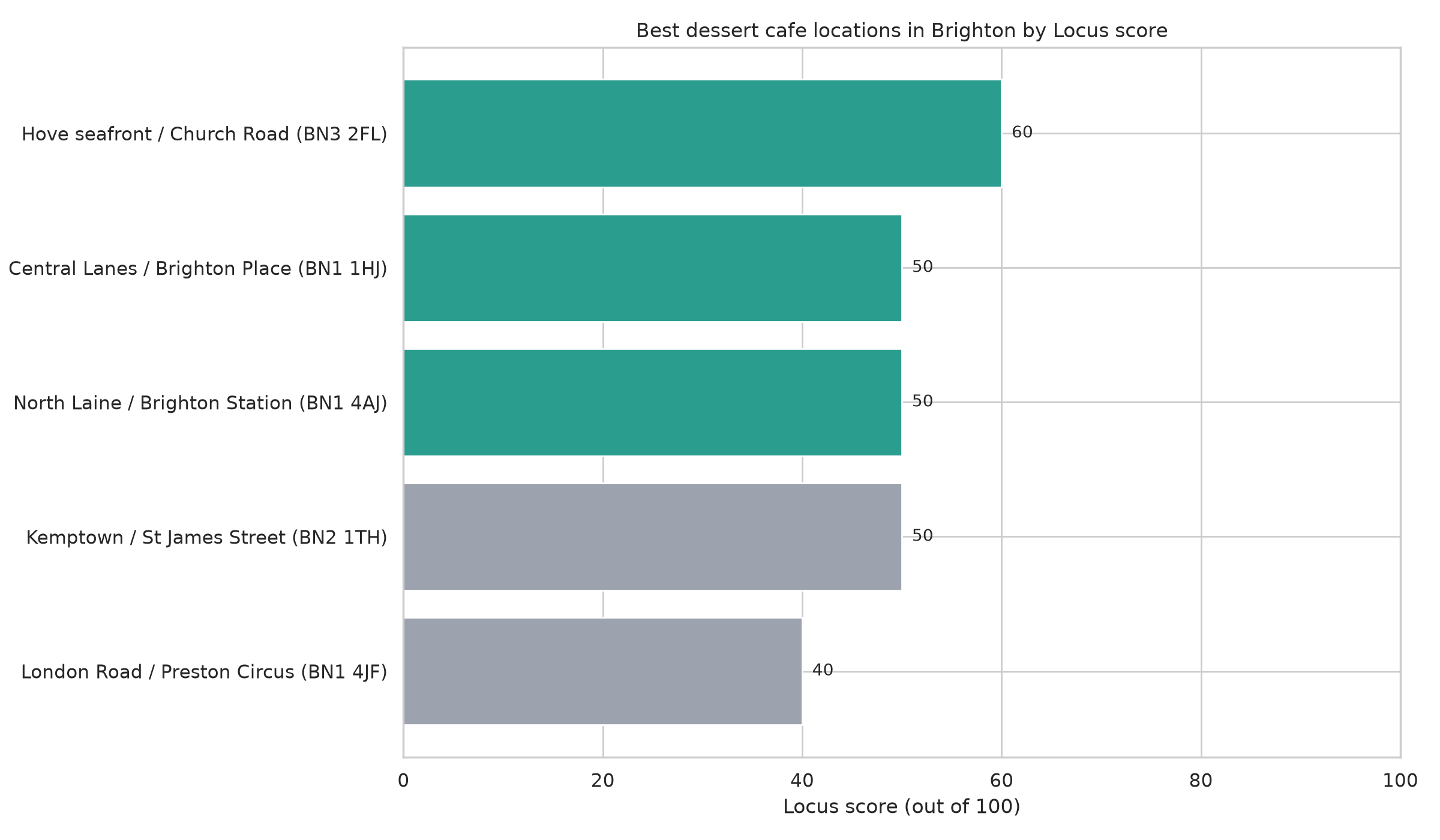
Hove seafront / Church Road ranked first, with a Locus score of 60/100. Central Lanes, North Laine, and Kemptown each scored 50/100. London Road / Preston Circus scored 40/100.
Hove's result is the most useful finding because it challenges the obvious first assumption. Many operators would start with central Brighton because it feels like the safest demand pool. Locus showed a more nuanced picture.
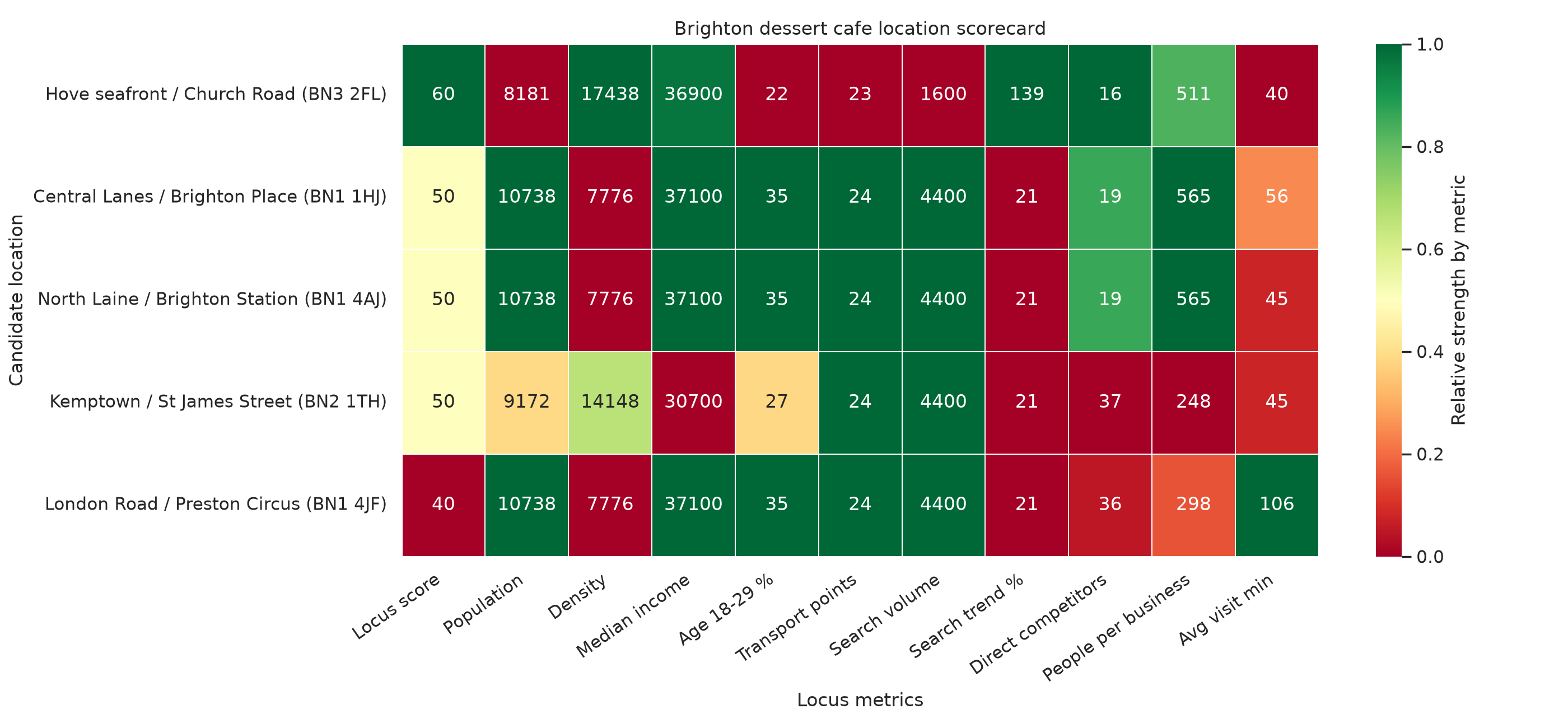
The Hove study point recorded 1,600 search volume and a 139.4% three-year trend. That volume is lower than the 4,400 recorded for the central Brighton runs, but the momentum is much stronger. For a seasonal dessert category, trend matters. It suggests the area is becoming more interesting for the relevant demand rather than simply relying on established city-centre volume.
Hove also showed the highest density in the study at 17,437.6 people per square kilometre, with median income of GBP 36,900. It had 23 transport points, Hove as the nearest train station, and the nearest bus stop 227 metres away. Locus identified 16 direct competitors, an average rating of 4.5, and 511 people per business.
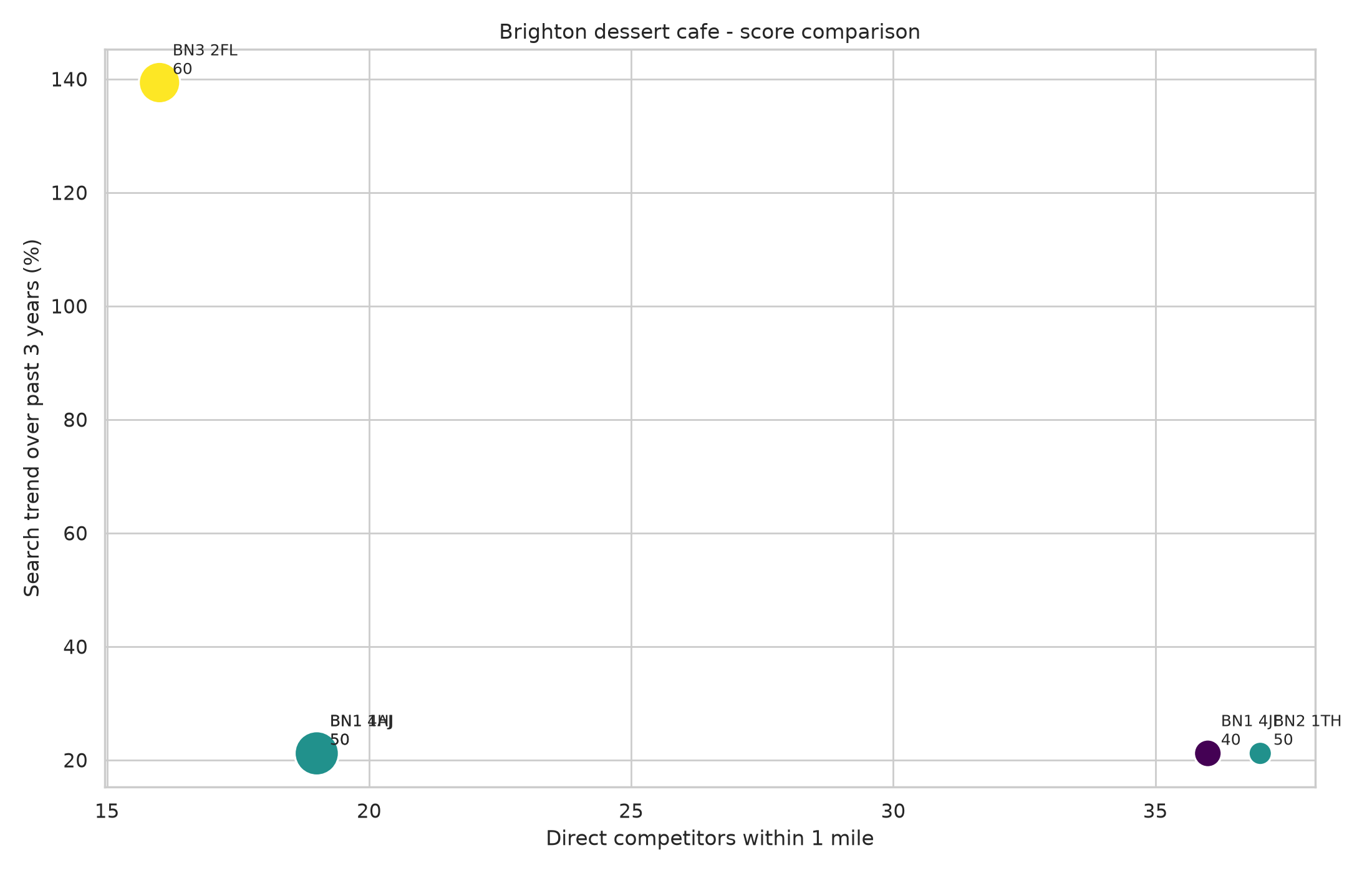
Central Lanes / Brighton Place scored 50/100. It had 10,738 people in the catchment, median income of GBP 37,100, a high 18-29 share of 35%, 24 transport points, search volume of 4,400, and 19 direct competitors. It remains a credible shortlist area, but the competition is visible. The Locus output suggests an operator would need a strong product angle rather than a generic dessert cafe.
North Laine / Brighton Station also scored 50/100. Its metrics were close to the Central Lanes run, but average visit duration was shorter at 45 minutes versus 56 minutes. That could suit a grab-and-go dessert or gelato format more than a longer dwell-time cafe. The area remains attractive for student, tourist, and station-linked footfall, but it is not automatically superior to Hove.
Kemptown / St James Street scored 50/100 with a different profile. It had 9,172 people in the catchment, density of 14,148.4 per square kilometre, 24 transport points, and an average competitor rating of 4.6. The weaker signals were median income of GBP 30,700 and much tighter customer-per-business economics, with 248 people per business. That does not rule Kemptown out, but it points to a more competitive, neighbourhood-led play.
London Road / Preston Circus scored lowest at 40/100. Locus recorded strong headline search volume, but the area had 36 direct competitors, 298 people per business, and an unusually long average visit duration of 106 minutes. That may reflect the mixed local activity pattern rather than clean dessert-cafe demand. For an operator, London Road would need more careful unit-level validation.
What This Means for Operators
The main lesson is that "central" and "best" are not the same thing. Central Brighton has demand, but it also has direct competition and obvious rent pressure. Hove looked better balanced in this study because it combined fast-rising demand, strong density, good accessibility, and manageable competitor pressure.
For an independent ice cream shop, Hove may be the strongest first shortlist. For a highly visual, tourist-oriented dessert concept, Central Lanes or North Laine could still make sense, but the concept needs sharper differentiation. For Kemptown, the operator would need a strong neighbourhood proposition. For London Road, the lease would need to be unusually compelling to offset the lower score.
All analysis was run in Locus, which scores locations using foot traffic data, demographic profiles, competitor mapping, accessibility, demand signals, and trade area analysis. The full study took under 30 minutes at locusintel.io.
Run your own location study free at locusintel.io.
Keep reading
Related guides from the Locus library.
AI-Powered Location Intelligence for Local Business Growth
How Locus brings competitor mapping, demographics, foot traffic, catchment analysis, local reputation tracking, and AI recommendations into one practical workflow.
How AI is Revolutionizing Location Intelligence for Businesses
Discover how artificial intelligence is transforming business location decisions. Learn about AI-powered site selection, predictive analytics, and automated insights.