

Where to Open a Budget Gym in Birmingham? A Site Selection Study
A Locus Birmingham screen compared 21 direct gym competitors, catchment context, access and visible reputation signals to define the next site-selection questions.
Ahmed
Founder of Locus
Opening a budget gym in Birmingham is not just a question of whether the city has enough people. It is a question of access, catchment, existing supply, reputation and the kind of competition a new operator would have to beat.
To make that decision more concrete, we ran an authenticated Locus study for Birmingham with the business type set to Gym / Fitness Centre, the niche set to Budget gym, and a 3-mile catchment around the selected location. The study found 21 direct competitors, with an average rating of 4.5. Locus then ranked visible competitor profiles by a performance score based on rating, reviews, review velocity and five-star share proxies.
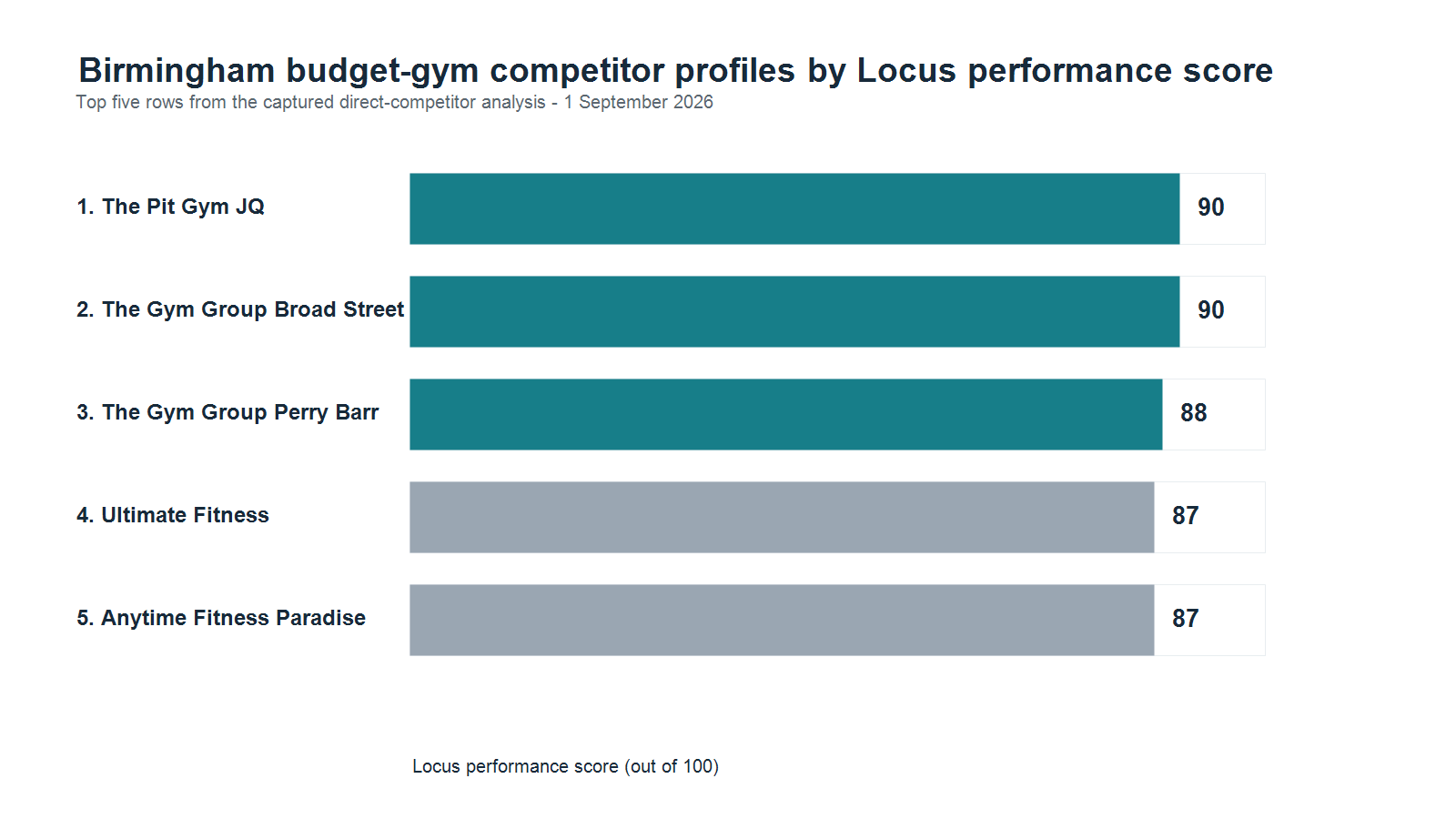
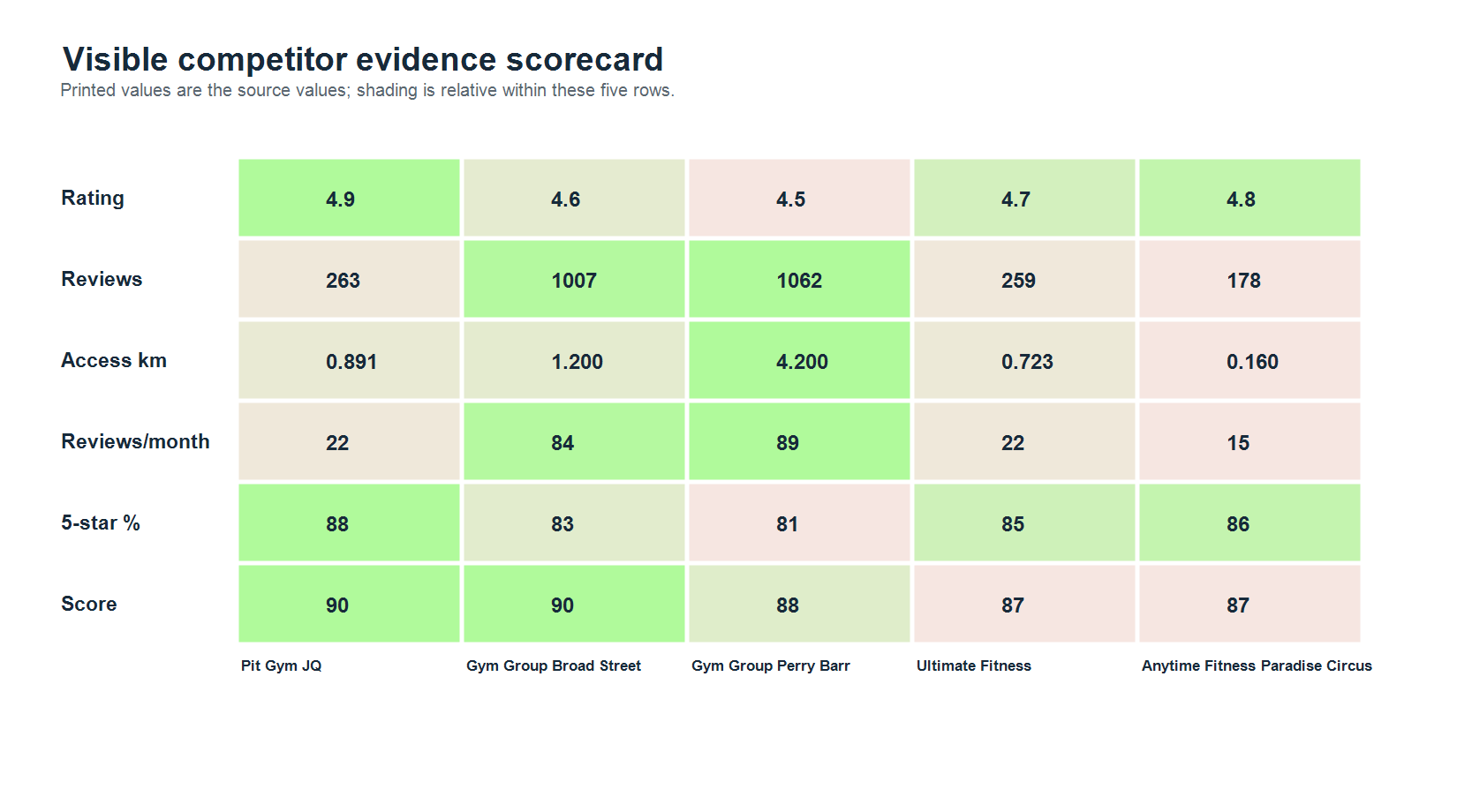
The headline result is a tie: The Pit Gym JQ Birmingham and The Gym Group Birmingham Broad Street both scored 90/100. They did not arrive there in the same way. The Pit had the stronger rating and five-star share. Broad Street had a much deeper review base and higher review velocity.
This is a competitor and catchment screen, not a claim that either business is the best vacant site or that the equal-share figure is measured market share.
Methodology
The run recorded values visible in the authenticated Locus map workflow on 1 September 2026. The parameters were Birmingham, Gym / Fitness Centre, Budget gym, and a 3-mile catchment. The result screen displayed demographics, accessibility, demand signals, nearby points of interest and a direct-competitor table. The top-five evidence is available in the study CSV, with the captured screen state preserved in the supporting research package.
Competitor discovery and profile metrics are Google Places-backed outputs surfaced by Locus. Distances are the straight-line access values shown by Locus. The performance score ranks competitor profiles. It does not rank vacant sites, predict revenue or recommend a lease.
This study also does not create a UK High Street Index ranking. The separate High Street Index evidence and limitations guide explains why the index needs a different evidence base. No GeoDS indicators or unvalidated geography crosswalk was used here.
The Birmingham catchment
The selected catchment contained a displayed population of 398,070 and a density of 7,138 people per square kilometre. Median household income was £30,971 against a displayed national average of £31,400. The age profile was concentrated in younger and working-age groups: 25% aged 18–29 and 28% aged 30–44, with 26% aged 0–17.
Access was a visible part of the picture. Locus showed 38 total transports in the area, with Birmingham New Street 333 metres away and Suffolk St Queensway Stop PC4 182 metres away. Nearby context also included Bullring at 605 metres, Birmingham Children's Hospital at 829 metres, Snow Hill Station Car Park at 450 metres and Aston University at 1.3 kilometres.
Those nearby places do not prove gym demand. They create a practical fieldwork brief. A future operator should check how commuters, students, staff, visitors and shoppers move through the actual frontage, and whether the unit can turn that movement into repeat membership.
The demand panel showed weekends as 2x busier, a morning peak, 26% average occupancy and a 105-minute average visit. It also showed average CPC of £1.23, search volume of 4.4K and a 23.2% change over the past three years. The screen explicitly said there was no reliable hourly signal today. These are Locus demand signals and estimates, not measured footfall counts. The visible weekly sample suggested stronger Saturday morning activity than the weekday rows, but it should be treated as directional until checked with observation or a stronger footfall source.
The competitor profile ranking
The Pit Gym JQ Birmingham appeared first in the detailed competitor analysis at 90/100. Its visible profile showed a 4.9 rating, 263 reviews, 22 reviews per month and an 88% five-star share. It was shown 891 metres from the selected location. This is a compact, high-reputation profile: strong rating, meaningful review depth and a high share of five-star reviews.
The Gym Group Birmingham Broad Street also scored 90/100. Its visible profile had a 4.6 rating but 1,007 reviews and 84 reviews per month, with an 83% five-star share. It was shown 1.2 kilometres away. Its competitive strength is different: a much larger and more active review footprint, even though its average rating is lower.
The Gym Group Birmingham Perry Barr ranked third at 88/100, with a 4.5 rating, 1,062 reviews, 89 reviews per month and an 81% five-star share at 4.2 kilometres. Ultimate Fitness Birmingham and Anytime Fitness Birmingham Paradise Circus completed the top five at 87/100. Ultimate Fitness showed a 4.7 rating, 259 reviews, 22 reviews per month and an 85% five-star share at 723 metres. Anytime Fitness showed a 4.8 rating, 178 reviews, 15 reviews per month and an 86% five-star share at 160 metres.
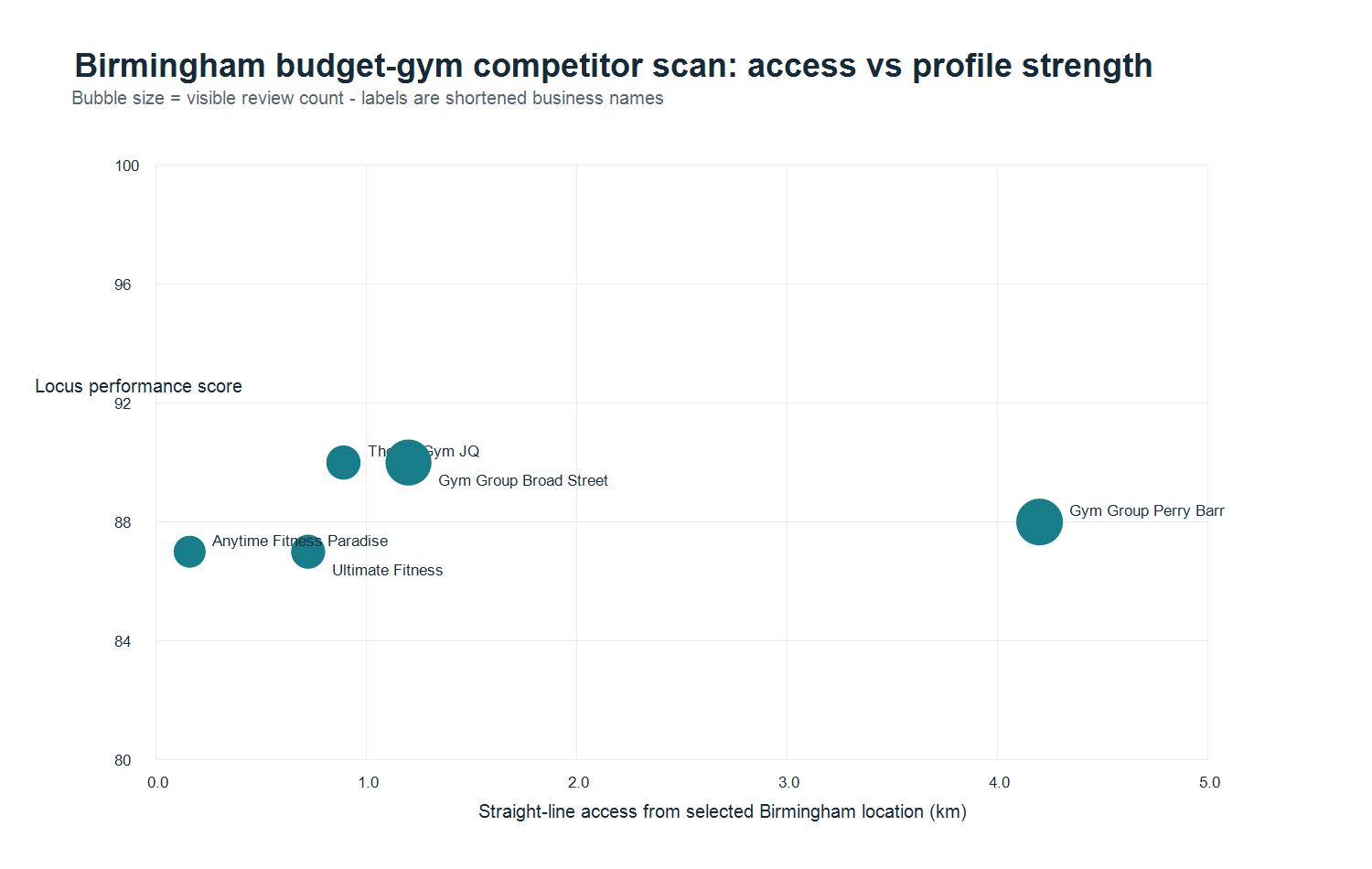
The surprise is that proximity and profile strength do not line up neatly. Anytime Fitness was the closest of the top five, while The Pit led the table. Broad Street was farther away than several competitors but matched the lead through review depth and velocity. A simple nearest-competitor lens would miss that difference.
The screen also displayed 21 direct competitors at a 4.5 average rating. Its equal-share indication was 398,070 divided by 21, or 18,956 people per business. That number is not measured market share. It assumes equal capture, says nothing about capacity or membership, and should not be used as a revenue forecast.
What this means for a budget-gym operator
First, treat Birmingham as a format-and-frontage problem, not only a population problem. The catchment is large and well connected, but the competitor set is substantial and includes national chains and highly rated local operators.
Second, decide which advantage the concept is trying to own. The Pit profile suggests that reputation and perceived quality can be powerful. Broad Street suggests that scale, review momentum and established visibility can create a different barrier. A new operator needs to say which of those it can realistically match or avoid.
Third, use the demand signals as prompts for fieldwork. Check Saturday morning and weekday commuting patterns in person. Validate the nearest transport links, parking friction, sightlines, building access, floor loading, ceiling height, opening-hour restrictions and whether the target unit is actually suitable for gym use.
Finally, do not skip the commercial model. Rent, service charge, fit-out, equipment, staffing, acquisition cost, local membership pricing and competitor promotions will decide whether a promising catchment becomes a viable business.
All analysis was run in Locus, which helps operators and property teams compare demographics, competitor mapping, accessibility and trade-area context before committing to a site. The product output is most useful when it narrows the next investigation and keeps its assumptions visible.
Keep reading
Related guides from the Locus library.
AI-Powered Location Intelligence for Local Business Growth
How Locus brings competitor mapping, demographics, foot traffic, catchment analysis, local reputation tracking, and AI recommendations into one practical workflow.
How AI is Revolutionizing Location Intelligence for Businesses
Discover how artificial intelligence is transforming business location decisions. Learn about AI-powered site selection, predictive analytics, and automated insights.