

Denver Coworking Space Site Selection: Validate the Member Pipeline Before the Lease
A fresh Locus screen of a Denver coworking catchment finds strong demographic and cycling signals, but dense competition and weak activity evidence make validation essential.
Adam
Marketing Manager
Does a central Denver coworking market justify site-level diligence? A fresh Locus screen says validate first. The catchment has a sizeable, relatively affluent working-age population and strong walking and cycling signals, but it also contains 36 direct competitors, a 5.2/10 location assessment and activity evidence that is too weak to stand in for occupancy.
That is not a city-wide verdict. It is a practical buyer decision: before a coworking operator commits to a unit, can the concept demonstrate a differentiated member pipeline, workable access and commercial terms that survive a crowded market?

What the Denver screen found
The study searched for Coworking Space around Denver, Colorado. Locus displayed a 20-minute drive catchment for travel context and a separate 10-mile radius for demographic data. Those geographies are not interchangeable, so the figures below describe the screen rather than a single clean customer boundary.
| Evidence | What Locus displayed | How to use it |
|---|---|---|
| Population in the demographic radius | 1,369,376 | Broad context, not a member forecast |
| Median household income | $89,332 | 19% above the displayed national comparison |
| Age 30–44 | 27% | A plausible professional and small-team segment |
| One-person households | 49% | Useful context for flexible-work hypotheses |
| Direct competitors | 36 | A dense discovery set that needs relevance checking |
| Average competitor rating | 4.6/5 | Review quality is not market share or occupancy |
| Competitors at 4.2+ | 33 | Little evidence of an obvious broad quality gap |
| Locus location assessment | 5.2/10 | Validate first, not a lease recommendation |
The screen also displayed a simple supply-density comparison of 38,038 people per direct competitor. That calculation is a useful way to describe the evidence, but it is not a prediction of customers, visits or utilisation.
The buyer decision is member fit, not population alone
The demographic profile gives an operator something testable. A 27% share aged 30–44, a 49% one-person-household share and median income above the displayed national comparison can support hypotheses about professionals, freelancers, small teams and private-office demand.
They do not prove that those people will pay for desks in the searched area. A useful pre-lease test would therefore define the member segment first, then ask whether a specific offer—quiet desks, team rooms, private offices, event access or a specialist community—can win enough expressions of interest to justify a unit review.
Denver's wider labour context adds useful perspective without answering that question. The U.S. Bureau of Labor Statistics reported 318.9 thousand professional and business-services jobs in the Denver-Aurora-Broomfield metro area in August 2026, up 0.2% year over year in its preliminary series. That is a regional employment signal, not evidence of coworking occupancy at a particular address.
Competition is the main constraint
The direct-competitor table contained 36 businesses with an average rating of 4.6. The AI assessment reported 33 at 4.2 or higher. The visible list included Spaces Civic Center, Coalition Space, WeWork Wells Fargo Center, Office Evolution, Strive Workspaces and Industrious, among others.
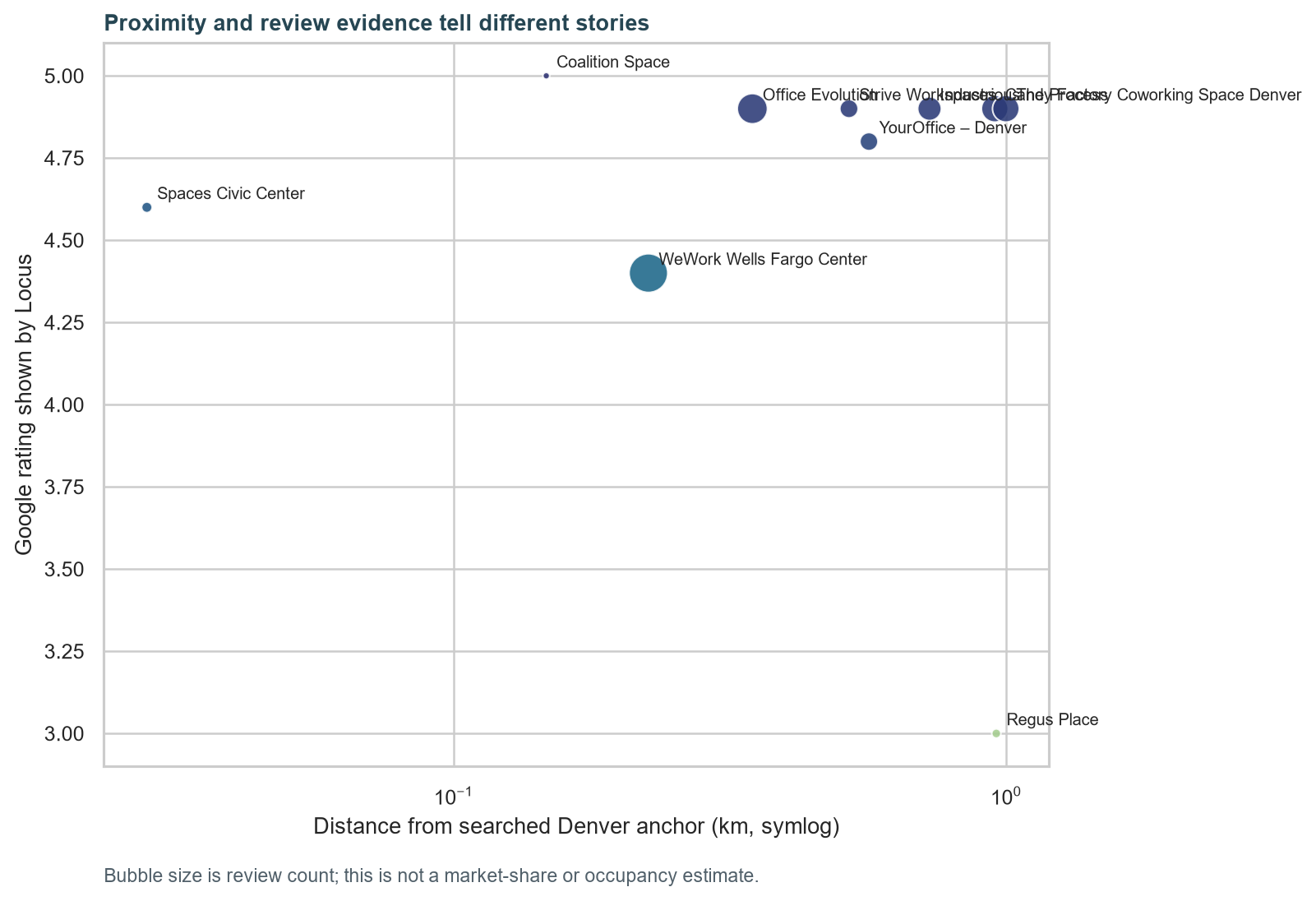
The mix matters more than the count. Coalition Space showed a 5.0 rating but only one review in the visible table. WeWork Wells Fargo Center showed 4.4 with 161 reviews. Office Evolution and Industrious combined high ratings with deeper review evidence. Those are different competitive signals: reputation, operating history, brand scale and local customer proof should not be compressed into one “competition” number.
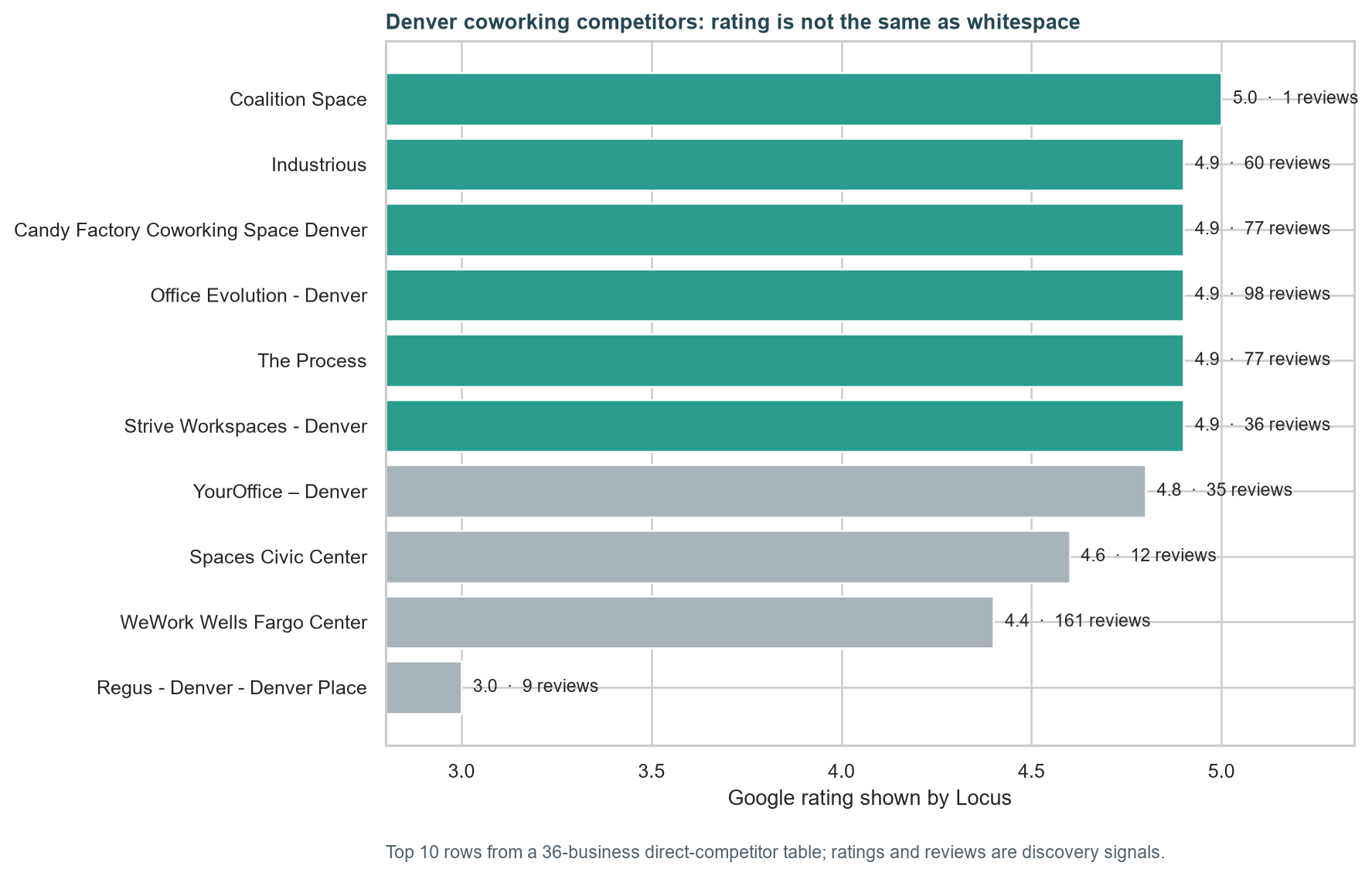
The result is not “there is no opportunity.” It is “a generic coworking offer has not shown enough whitespace.” The next question is which member group, use case or operating format is underserved—and whether the proposed premises can reach it better than the existing set.
Access is promising, but the evidence needs reconciliation
The accessibility panel showed a Walk Score of 76, Bike Score of 97 and Transit Score of 54. It also listed a bus stop 74 metres away. The AI assessment separately stated that no transit stops were recorded within 500 metres. Because those two product outputs conflict, the exact access evidence is not settled and should be checked at the candidate premises.
That conflict is itself useful. A coworking decision depends on the commute people will actually make: the entrance, street crossing, secure cycle storage, parking cost, evening safety, bus frequency and the route from the nearest station. A strong cycling score cannot compensate for an access problem experienced by the target member segment.
Demand signals are hypotheses, not occupancy
The Locus demand panel displayed weekends as 1.7 times busier, morning as the peak period, an average visit of 142 minutes and a mean observed activity index of 16/100. Its weekly relative pattern was strongest on Monday and Saturday, with lower values from Tuesday through Friday.
These observations suggest a validation brief: test weekday workday behaviour instead of assuming that weekend activity translates into recurring desk demand. The activity layer contains hourly cells and a relative index; it does not report coworking occupancy, member retention, desk utilisation or pass-by conversion.
Locus also displayed a keyword signal of approximately 1,000 monthly searches, a $16.79 cost-per-click value and a 55.2% decline over the displayed period. The period and method for that change were not exposed in the product view, so the decline is recorded as an exploratory hypothesis rather than a standalone market-trend conclusion. A real demand test should use the exact offer and geography, then compare qualified enquiries with actual follow-through.
Why the score is 5.2/10
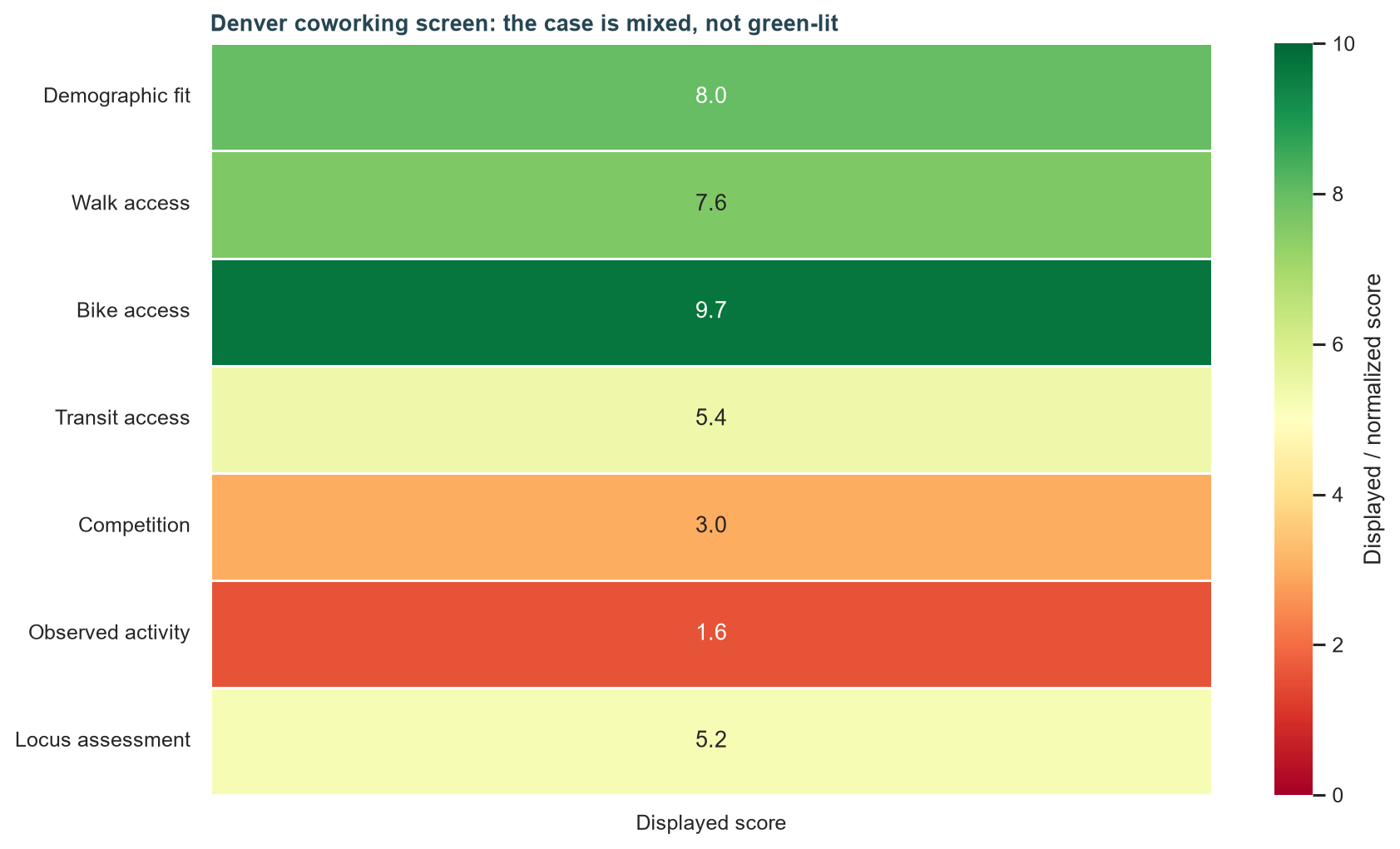
The Locus assessment combined demographics, accessibility, competition, demand and momentum. It displayed component scores of 8/10 for demographics, 6/10 for accessibility, 3/10 for competition, 6/10 for demand and 3/10 for momentum, resulting in a 5.2/10 overall score and a Validate first label.
The score is useful because it exposes the trade-off. Demographic fit and cycling access are not enough to overcome dense, well-rated supply and weakly explained activity evidence. The sensible output is a list of questions for a real site—not a universal ranking of Denver neighbourhoods.
The next validation questions
Before advancing a Denver coworking concept to a lease conversation, an operator should:
- Define the member segment and offer, then collect expressions of interest or presales from that specific audience.
- Rebuild the competitor set around the actual format, separating coworking, serviced offices, private offices, event-led spaces and adjacent substitutes.
- Visit candidate premises at weekday morning, lunchtime and evening periods; record access, noise, safety, parking, cycle storage and the real route from transit.
- Gather current desk, private-office, meeting-room and membership prices rather than using ratings as a proxy for commercial performance.
- Test the catchment and unit economics together. Rent, vacancy, fit-out, service charges, staffing and achievable member conversion remain outside this screen.
The practical conclusion is narrow: the Denver catchment is worth validating, but the evidence does not support treating it as lease-ready. A differentiated member proposition and a site-specific access and pricing check are the next decision gates.
For the broader workflow, start with trade area analysis before comparing addresses, then use site selection analytics for competitive catchments to keep access, supply and demand in the same discussion. Locus provides the location evidence workflow for a free site analysis.
Sources and methodology
- Locus map workflow — authenticated Denver, Colorado coworking-space screen observed 3 October 2026. The study used the displayed 20-minute drive catchment, a separate 10-mile demographic radius, Locus demographics, accessibility, activity, competitor and AI-assessment panels.
- U.S. Census Bureau QuickFacts: Denver city, Colorado — current city context, kept separate from the Locus catchment figures.
- U.S. Bureau of Labor Statistics: Denver-Aurora-Broomfield economy at a glance — preliminary August 2026 metro employment context, retrieved 3 October 2026.
- Competitor discovery and profile metrics are location signals surfaced by Locus. Category relevance, duplicate brands, review completeness and current pricing should be checked before commercial use.
- The location score is a screening composite. It is not a revenue forecast, occupancy estimate, measured footfall count, market-share estimate, investment return or lease recommendation.
Last updated: 3 October 2026.
Keep reading
Related guides from the Locus library.
AI-Powered Location Intelligence for Local Business Growth
How Locus brings competitor mapping, demographics, foot traffic, catchment analysis, local reputation tracking, and AI recommendations into one practical workflow.
How AI is Revolutionizing Location Intelligence for Businesses
Discover how artificial intelligence is transforming business location decisions. Learn about AI-powered site selection, predictive analytics, and automated insights.