
B2B Location Prospecting: Find Better Local Business Leads
Learn how B2B teams can use location intelligence to prioritise local prospecting, map business clusters, and focus outreach by territory.
Sara
Head of Growth
B2B prospecting usually starts with lists.
Sales teams filter by industry, company size, job title, and geography. That works for broad outreach, but it misses an important question: where are the local business clusters that make outreach more efficient?
B2B location prospecting uses location intelligence to prioritise territories, identify dense pockets of relevant businesses, and focus outreach around the places where demand is most likely to exist.
What Is B2B Location Prospecting?
B2B location prospecting is the process of using geographic and local-market data to find, segment, and prioritise business prospects.
Instead of treating a city as one market, you break it into practical territories:
- Neighbourhoods with high business density
- Clusters of target sectors
- Areas with strong foot traffic or consumer demand
- Competitor-heavy zones that may need better suppliers
- Underserved areas where businesses may be growing
For agencies, suppliers, consultants, local service providers, and franchise development teams, this creates a more targeted prospecting workflow.
Why Location Matters in B2B Outreach
Many B2B products are still shaped by place.
A food supplier cares where restaurants cluster. A marketing agency may prioritise high streets with independent operators. A commercial real estate advisor may look for expanding brands in specific catchments. A franchise development team may look for operators in territories with strong demographic fit.
Location intelligence helps answer:
- Which areas contain the highest concentration of target businesses?
- Which businesses are surrounded by strong customer demand?
- Which territories are saturated, underserved, or changing?
- Where should outreach start this week?
The result is not just a bigger list. It is a better order of attack.
A Practical B2B Location Prospecting Workflow
Start with the target business type.
For example, a supplier may want independent cafes, restaurants, gyms, salons, clinics, or convenience stores. A franchise team may want operators in areas that match the brand's customer profile.
Next, map the local market. Look for density, clusters, adjacent businesses, and competitor patterns. A dense cluster may be efficient for field sales. A scattered market may need digital outreach first.
Then prioritise by opportunity:
- Strong demand signals
- Good demographic fit
- High local activity
- Weak competitor reputation
- Recent business growth
- Strategic territory coverage
Finally, turn the map into outreach batches. Instead of contacting every possible business, focus on a territory with a clear reason: strong demand, underserved customers, or visible competitive movement.
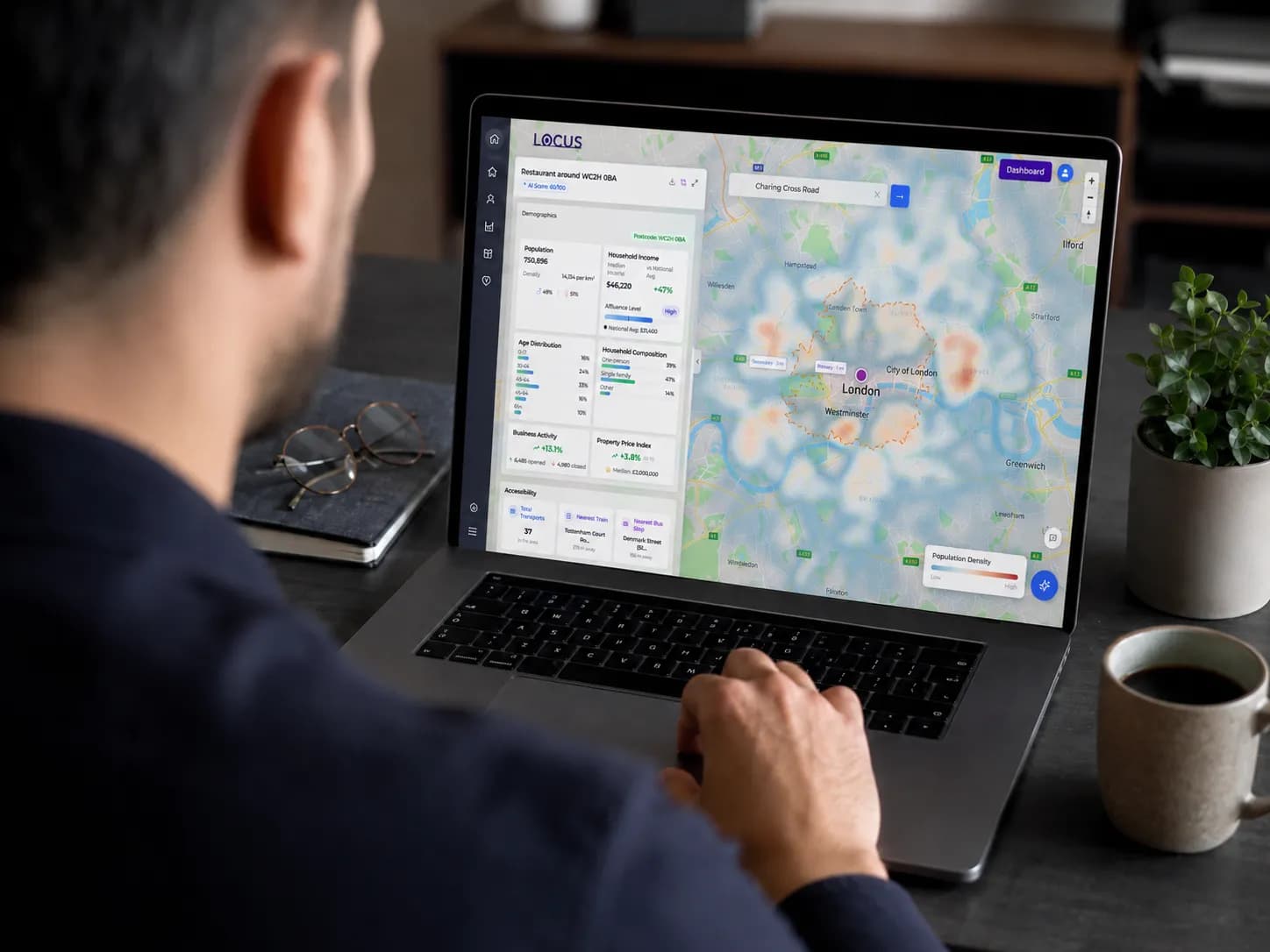
How Locus Supports Prospecting by Territory
Locus is primarily built for site selection and local market analysis, but the same signals can help B2B teams focus prospecting.
You can use Locus to understand local business density, competitor context, demographic fit, and catchment dynamics before deciding where to focus outreach. For teams selling into local operators, those signals can make prospecting more relevant.
For example:
- A supplier can identify restaurant clusters before a field-sales visit.
- A consultant can target local businesses facing heavy competitor pressure.
- A franchise team can identify territories where operators may be interested in expansion.
- A CRE advisor can understand which occupier types fit a neighbourhood.
This pairs naturally with competitor proximity analysis and AI location intelligence for small business.
The Bottom Line
B2B prospecting improves when geography becomes part of the strategy.
Location intelligence helps teams move from generic lead lists to territory-aware outreach. It shows where target businesses cluster, where demand may be stronger, and where a message can be tied to local context.
That makes outreach more focused, more relevant, and easier to prioritise.
Keep reading
Related guides from the Locus library.
AI-Powered Location Intelligence for Local Business Growth
How Locus brings competitor mapping, demographics, foot traffic, catchment analysis, local reputation tracking, and AI recommendations into one practical workflow.
How AI is Revolutionizing Location Intelligence for Businesses
Discover how artificial intelligence is transforming business location decisions. Learn about AI-powered site selection, predictive analytics, and automated insights.