
Best Manchester City Centre Locations for a Coffee Shop: A Site Selection Study
We compared Market Street, St Ann's Square, New Cathedral Street, Exchange Square, and King Street for an independent coffee shop using Manchester footfall and FSA competitor-density data.
Sara
Head of Growth
Manchester city centre has the ingredients a coffee operator wants: office workers, shoppers, students, tourists, transport nodes, and a strong independent food-and-drink culture. But choosing a site still requires more than walking the busiest street and counting people.
For this study, we compared five Manchester BID retail districts for an independent coffee shop: Market Street, St Ann's Square / Acresfield, New Cathedral Street, Exchange Square / Arndale Steps, and King Street.
The headline finding: Exchange Square / Arndale Steps ranked first, not Market Street. Market Street had the highest measured footfall, but Exchange Square had stronger year-on-year momentum and lower nearby food-service density.
Methodology
The study used CityCo's Manchester City Centre Monthly Footfall reporting for June 2026, covering the period from 31 May 2026 to 4 July 2026. CityCo's monitored retail district cameras track Market Street, St Ann's Square, New Cathedral Street, King Street, and Exchange Square.
We then used the Food Standards Agency Food Hygiene Rating Scheme API to count Manchester Restaurant/Cafe/Canteen records near each candidate point. This is not a perfect coffee competitor dataset because it includes restaurants and canteens as well as cafes. It is still a useful public proxy for food-service density and customer-choice pressure.
Finally, we created a transparent Locus-style score:
- Footfall volume: 40%
- Year-on-year footfall momentum: 20%
- Food-service competitive headroom: 20%
- Coffee-name proxy headroom: 10%
- Average visible hygiene rating quality: 10%
This is a shortlist study, not a lease recommendation. A final decision still needs exact unit rent, frontage, extraction, visibility, fit-out condition, hours, landlord incentives, and customer dwell-time assumptions.
Download the study data as CSV to review the five candidate areas, component metrics, and notes used in the comparison.
The results
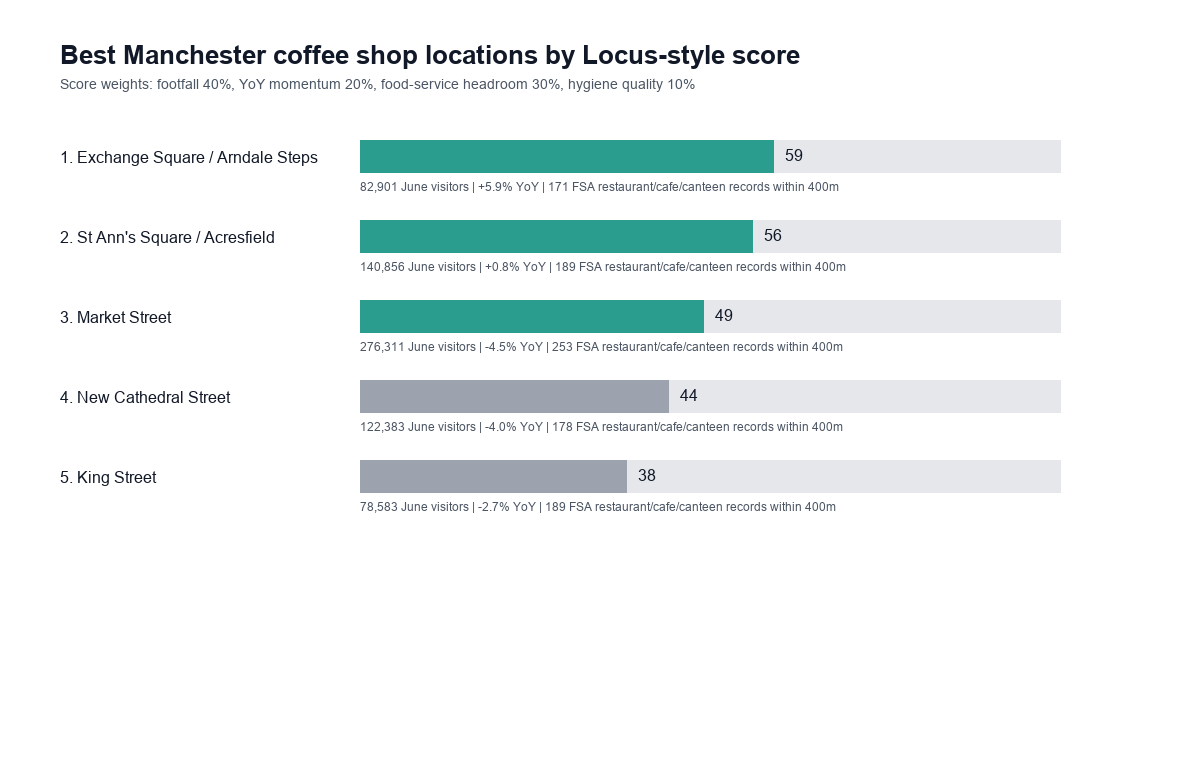
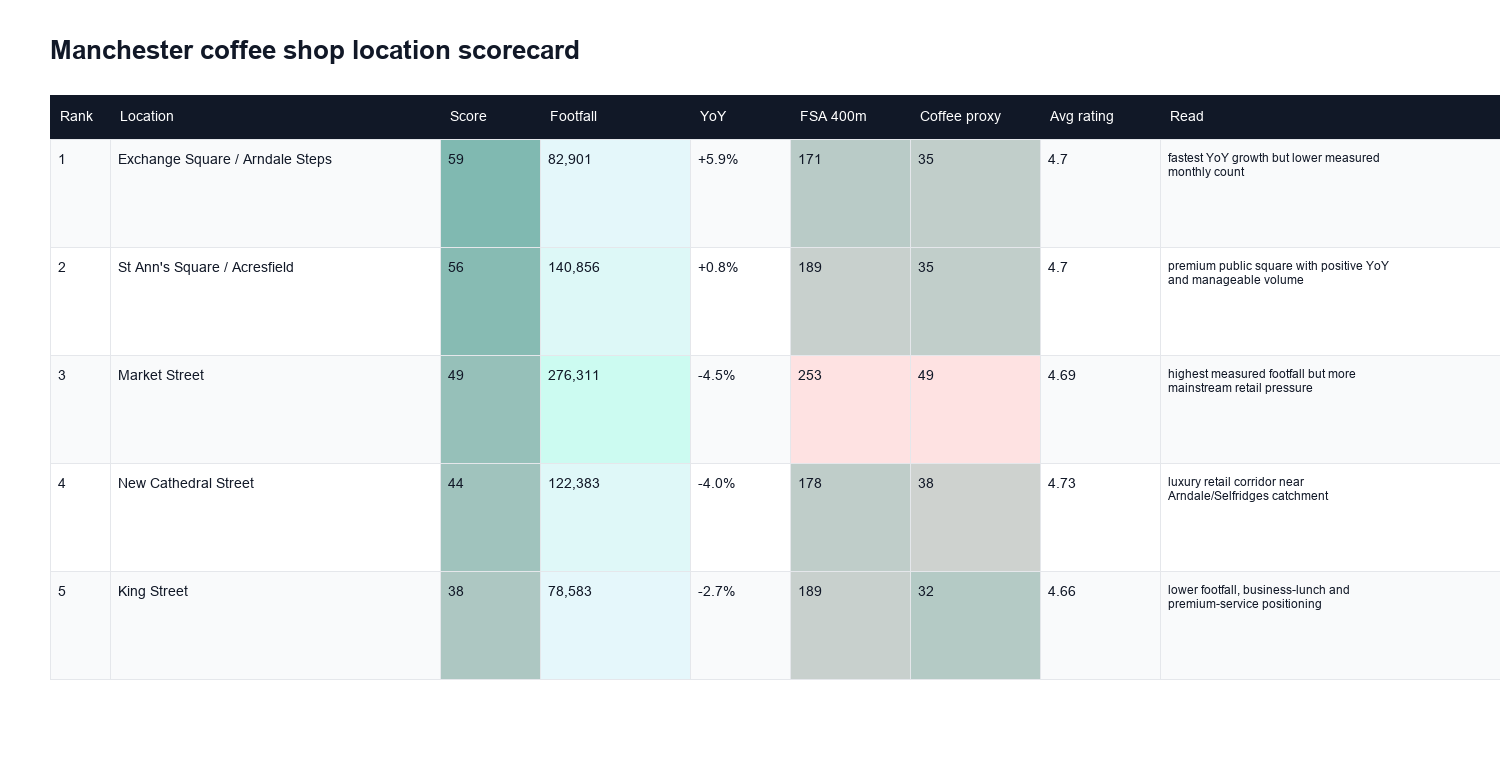
Exchange Square / Arndale Steps ranked first with a score of 59. It had 82,901 measured June visitors and was up 5.9% year on year. That was the strongest momentum in the dataset. The area also had 171 FSA restaurant/cafe/canteen records within 400 metres, materially below Market Street's 253.
That does not mean Exchange Square has no competition. It does mean the balance of footfall direction and competitive headroom looked better than the more obvious Market Street option.
St Ann's Square / Acresfield ranked second with a score of 56. It recorded 140,856 June visitors and was up 0.8% year on year. Its 400-metre food-service count was 189. For an independent coffee shop, this may be the most commercially balanced candidate: enough measured demand, a premium public-square environment, and less direct crowding than Market Street.
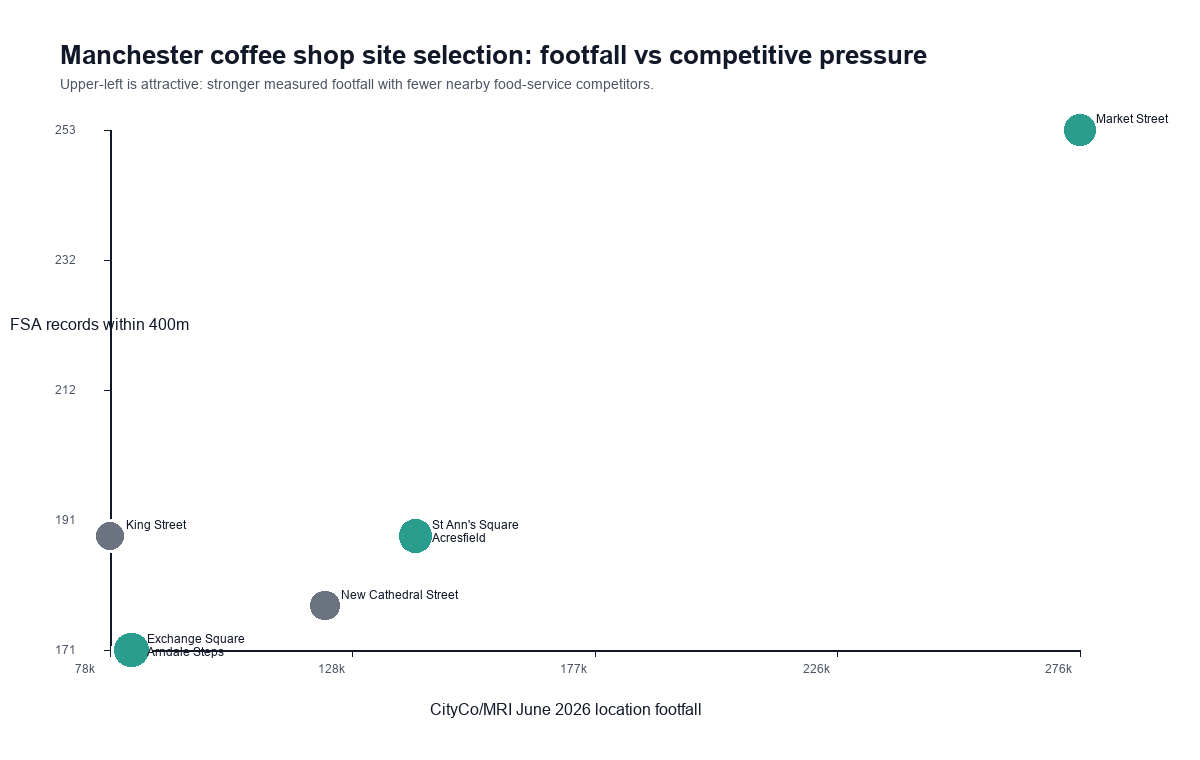
Market Street ranked third with a score of 49. The raw count was impressive: 276,311 June visitors. But Market Street also had the densest food-service field in the study, with 253 restaurant/cafe/canteen records within 400 metres and 49 coffee-name proxy records. Its footfall was down 4.5% year on year.
The lesson is simple: the busiest street is not automatically the safest lease. A high-throughput chain may be able to convert Market Street's flow. An independent operator would need a sharper product, strong frontage, and rent assumptions that leave room for competition.
New Cathedral Street ranked fourth with a score of 44. It recorded 122,383 June visitors and was down 4.0% year on year. Its competition count was better than Market Street's, but it did not have the positive momentum of Exchange Square or the balanced demand profile of St Ann's Square.
King Street ranked fifth with a score of 38. It had 78,583 measured June visitors and was down 2.7% year on year. That does not make it a bad coffee location. It may suit a premium, business-led, or specialty concept. But from this model, it is not the strongest volume-led first shortlist.
What this means for coffee-shop operators
If you are opening an independent coffee shop in Manchester, Exchange Square and St Ann's Square deserve the first look. Exchange Square has the best momentum signal. St Ann's Square has the strongest balance of demand and setting.
Market Street should not be dismissed, but it should be stress-tested. The footfall is real. So is the density of nearby food-service options. A weak or generic offer can disappear in that environment.
New Cathedral Street and King Street are more format-specific. They may work for a premium or commuter-focused concept, but the data does not support treating them as the strongest all-round options.
The wider lesson is that site selection needs multiple signals. Footfall, momentum, competitor density, customer fit, and exact unit economics all matter. A location can look perfect on one metric and risky on another.
All analysis was prepared for Locus, which helps operators compare foot traffic, competitor mapping, demographics, and trade-area fit before they commit to a site. The source-backed study used public CityCo/MRI footfall data and Food Standards Agency open data, then applied a transparent Locus-style scoring model.
Keep reading
Related guides from the Locus library.
AI-Powered Location Intelligence for Local Business Growth
How Locus brings competitor mapping, demographics, foot traffic, catchment analysis, local reputation tracking, and AI recommendations into one practical workflow.
How AI is Revolutionizing Location Intelligence for Businesses
Discover how artificial intelligence is transforming business location decisions. Learn about AI-powered site selection, predictive analytics, and automated insights.