
Leeds Brunch Café Site Selection: A Dense Catchment with a Narrower Question
A postcode-level Locus screen around LS1 4DY finds 16 brunch-café competitors and a young, one-person-heavy catchment. Here is what to validate next.
Ahmed
Founder of Locus
An address-level screen around LS1 4DY in Leeds city centre finds a large, young catchment and a serious existing brunch offer. The opportunity question is therefore not “Does Leeds have enough people?” It is more specific: can a new café win a distinct occasion in a compact, well-reviewed competitive set?
This is a screening study, not a lease recommendation. It turns one candidate postcode into a short validation brief for an operator, franchise team or property adviser.
What the LS1 4DY screen found
The study used a 10-minute drive catchment for travel context and a separate one-mile radius for demographic data. Those geographies answer different questions and should not be treated as one customer boundary.
| Evidence | What Locus displayed | How to use it |
|---|---|---|
| Population in the one-mile radius | 31,998 | A broad local context, not a customer forecast |
| Population density | 5,958.5 people/km² | Indicates a compact urban market |
| Median income | £26,636 | 15% below the displayed national comparison |
| Ages 18–29 | 50% | Supports a young-customer occasion hypothesis |
| One-person households | 49% | Useful context for solo visits and flexible routines |
| Direct competitors | 16 | A focused set for offer and occasion comparison |
| Average competitor rating | 4.7/5 | Review quality is not market share or occupancy |
| Equal-share comparison | 2,000 people per competitor | A division of displayed population by displayed competitors, not demand |
The demographic profile is interesting because it is not a simple premium-income story. A young, dense, one-person-heavy catchment could support breakfast, coffee, study, social and convenience occasions—but the lower displayed median income makes price architecture and repeat frequency questions important.
Competition is strong, but not uniform
The visible competitor set averaged 4.7/5 across 16 businesses. The closest businesses included Federal Cafe Bar, Coffee28 Leeds City Centre, Moose Coffee, ELDA cafe & bistro, IF BRUNCH and The Clubhouse Coffee Leeds. Distances in the table are proximity signals from the product screen, not walking routes or trading-area boundaries.
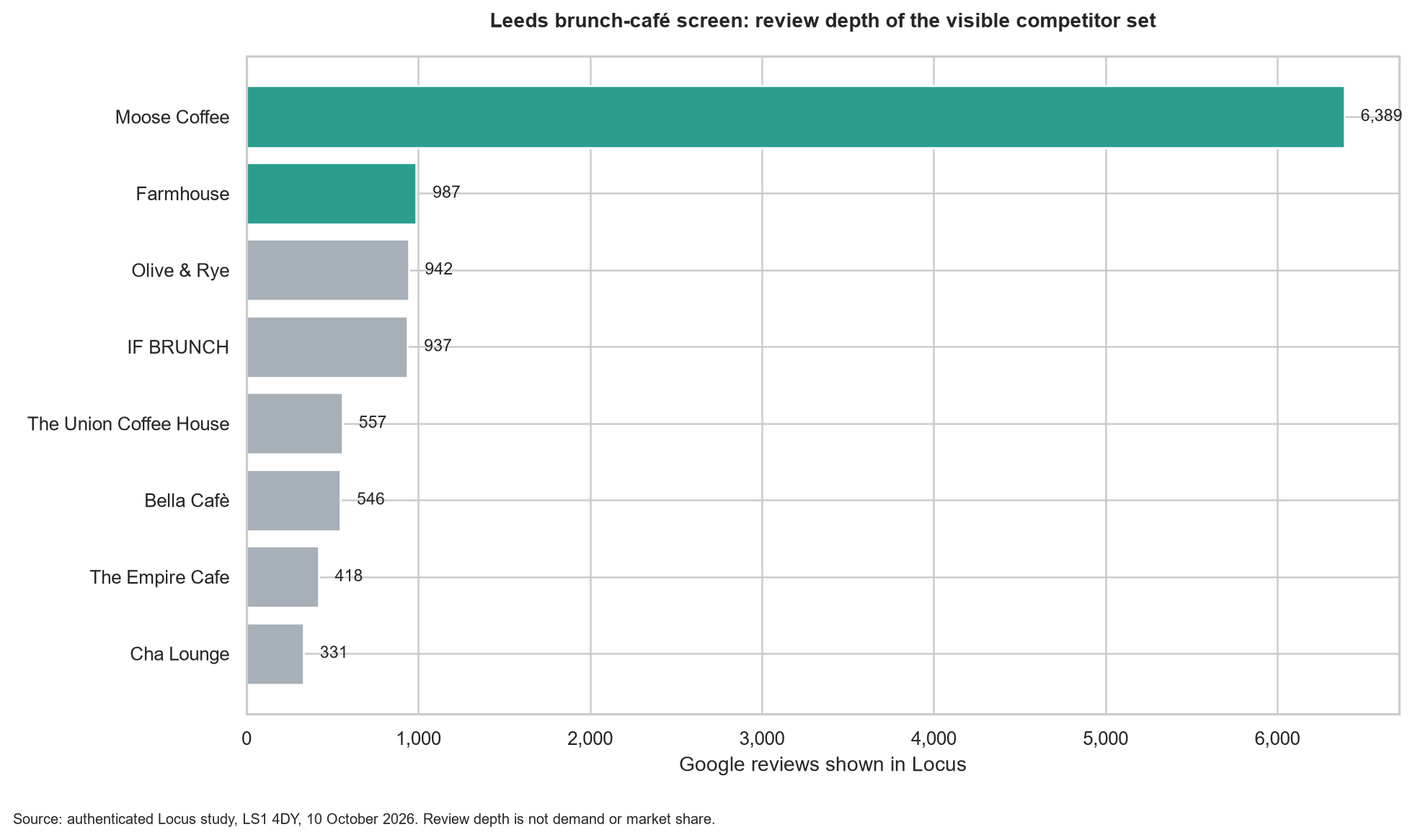
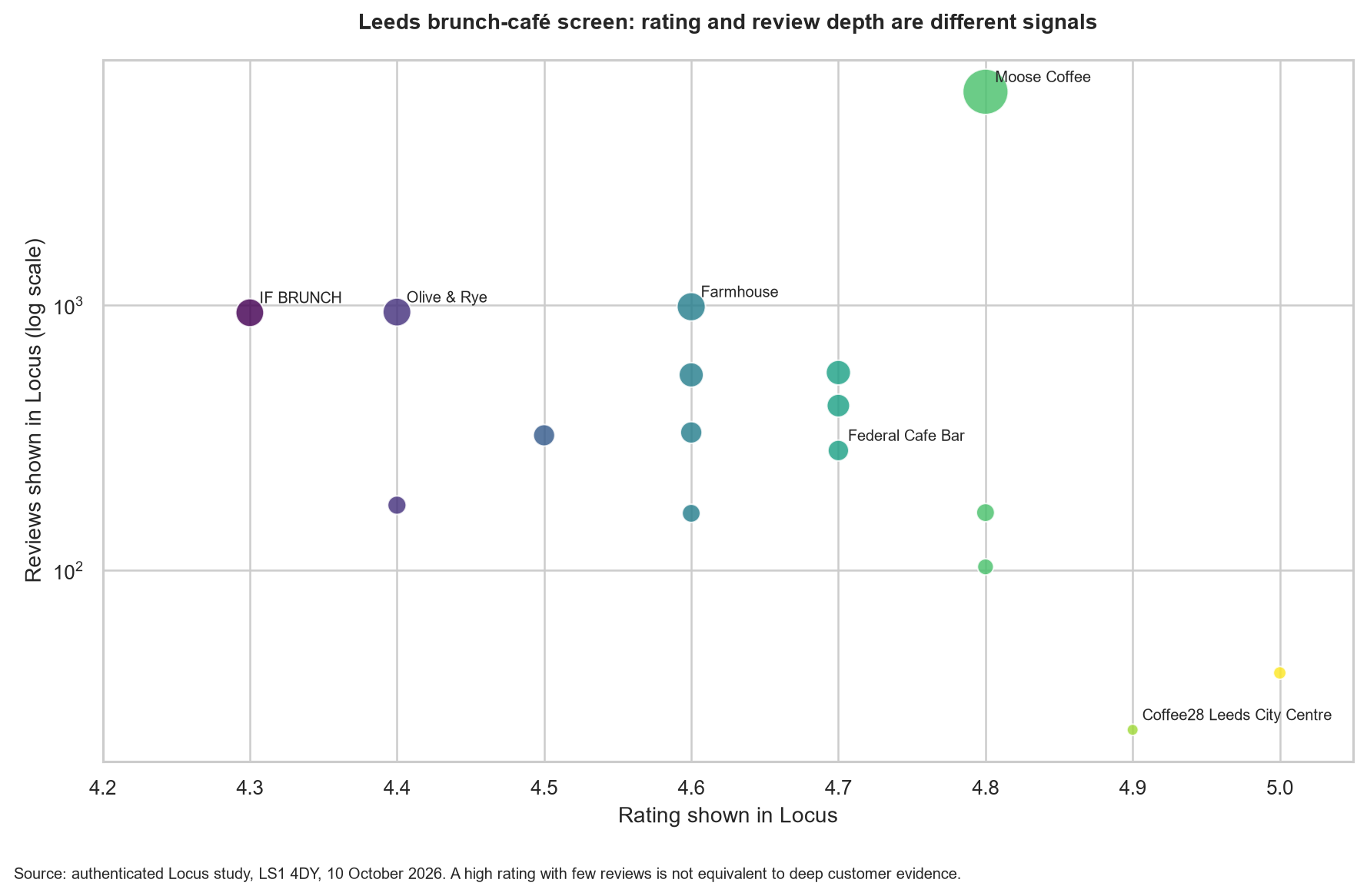
The list also shows why a single average can hide the decision. Moose Coffee displayed 4.8 with 6,389 reviews, while Coffee28 displayed 4.9 with 25 reviews and ELDA displayed 5.0 with 41. A high rating with deep review volume is different evidence from a high rating with a small public review base.
The simple “2,000 people per competitor” figure is best read as an equal-share comparison. It does not mean each business can serve 2,000 people, and it does not estimate revenue, visits, occupancy or market share. It simply keeps the population headline connected to the visible supply count.
The site decision is about a distinct occasion
For a new brunch café, the useful next question is not whether the area is popular in general. It is whether the concept can own a specific occasion better than the existing set.
Possible hypotheses include:
- a fast weekday breakfast for station and office trips;
- an affordable solo lunch or study-friendly offer for younger residents;
- a higher-value weekend brunch with a reservation or group format; or
- a menu and service pattern that fills a gap between coffee-led operators and full brunch restaurants.
The catchment supports testing those hypotheses, but it does not choose one. The 49% one-person-household share is a clue about household structure, not proof that solo diners want a particular menu. The age profile is a clue about potential occasions, not a forecast of spending.
Access and city-centre context need a site walk
The screen recorded 35 transport points and surfaced nearby retail, workplace, university and station-related points of interest. That is useful for forming a visit-pattern brief, but the product output does not replace a walk of the actual frontage. Entrance visibility, crossings, shelter, cycle storage, loading, evening safety and the route from Leeds station can change the practical catchment.
Leeds City Council reported more than 45 million city-centre visits so far in 2026 and an 8.8% city-centre vacancy rate in September 2026. Those are useful city-centre context signals, not evidence that this postcode will capture a share of the footfall. Leeds City Council’s update gives the broader context.
The wider city also has scale: the 2021 Census counted about 812,000 people in Leeds, up 8.1% from 2011. That city-level trend does not resolve a unit-level brunch decision, but it helps explain why a central catchment can be both attractive and crowded. The Office for National Statistics Leeds profile provides the population context.
What this screen does not tell you
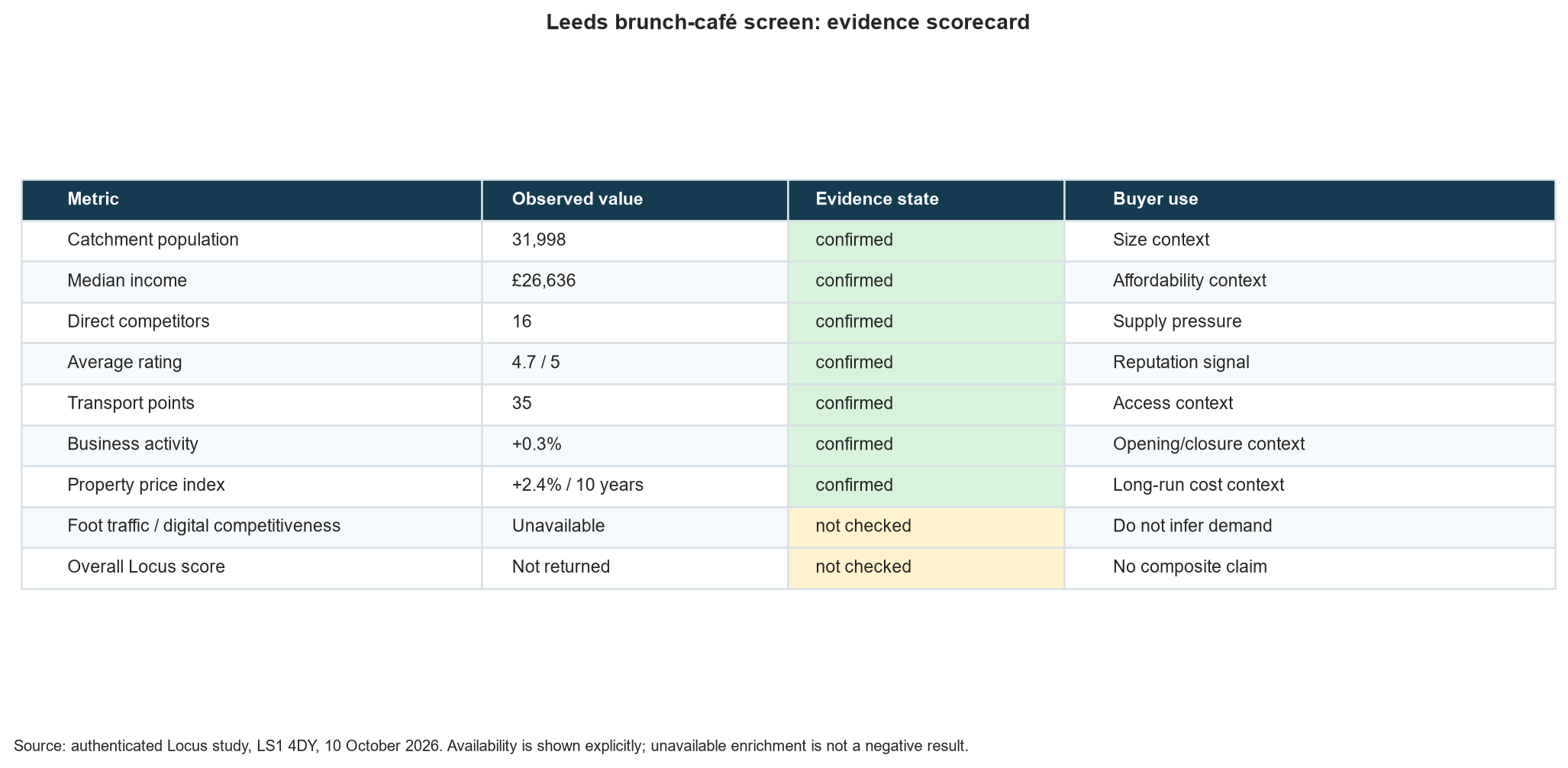
The full research view did not return a usable foot-traffic or digital-competitiveness layer for this location. It also did not return a final overall location score. That is not a negative demand finding; it is a coverage limit.
The next validation should therefore combine the screen with:
- a frontage and access walk at weekday breakfast, weekday lunch and weekend brunch periods;
- current asking rent, rates, service charge, fit-out and extraction constraints;
- a competitor visit log covering queue length, seating turnover, menu price and service speed; and
- a small demand test tied to one concrete offer, measuring qualified enquiries or pre-orders rather than generic interest.
The strongest decision may be to refine the concept before refining the postcode. If the offer cannot explain why a customer would choose it over a well-rated existing set, more population data will not create the missing differentiation.
A repeatable first screen for the next site
Locus is useful here because it puts the first comparison around an exact candidate address: catchment context, demographics, nearby competitors, access points and the evidence gaps that still need fieldwork. For the broader workflow, see how trade areas shape business decisions and competitive catchment analysis.
When the next address is ready, run a free Locus site analysis and keep the result beside the commercial and on-the-ground checks. The output should narrow the question—not pretend to settle it.
Sources and methodology
The local screen was captured in Locus on 10 October 2026 for the searched category Brunch cafe and postcode LS1 4DY, Leeds. Competitor names, ratings, review counts, proximity values, demographic figures and transport/point-of-interest counts are the values displayed in that screen. The one-mile demographic radius and 10-minute drive catchment are separate contexts.
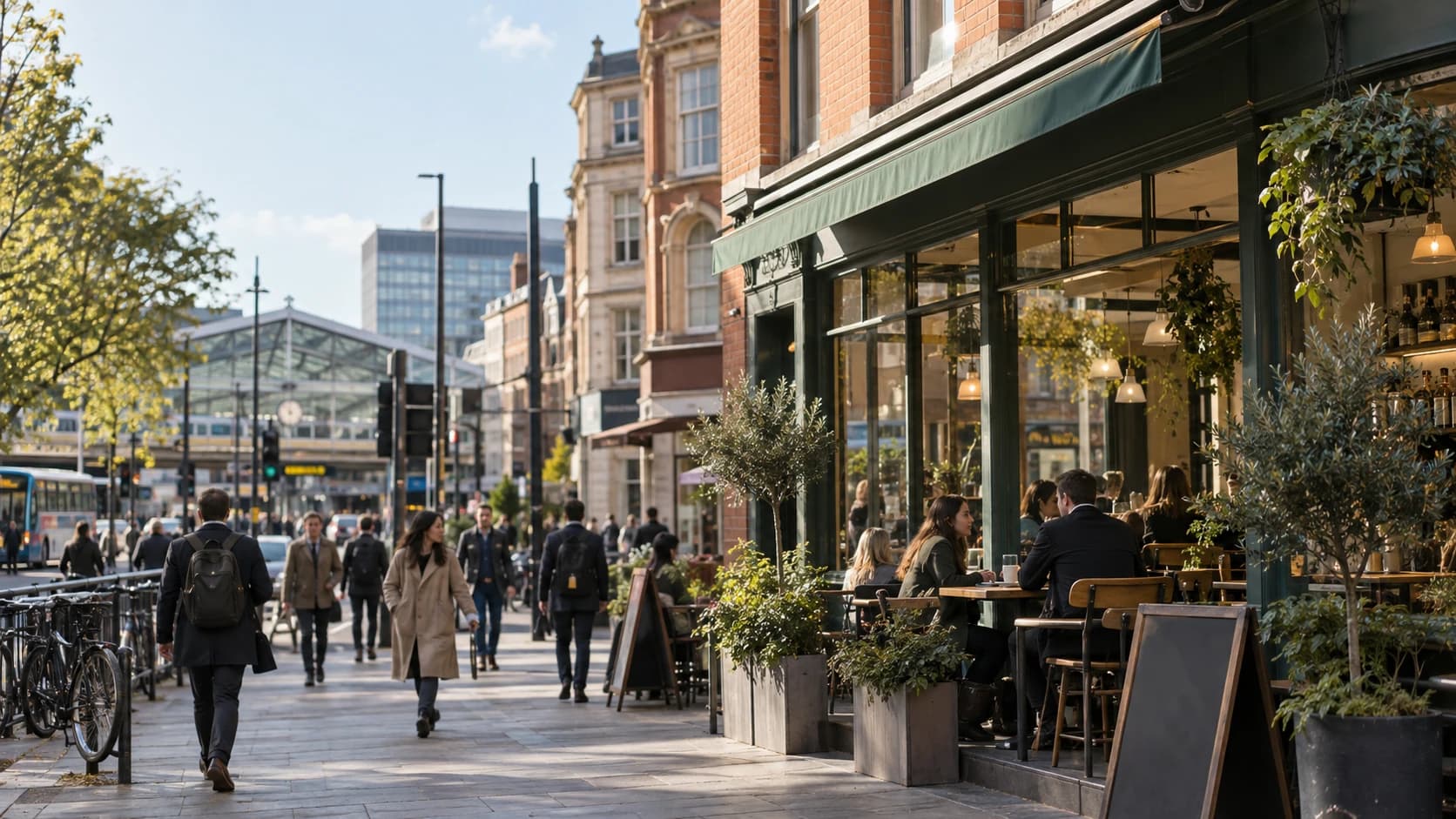
The Leeds-wide population and city-centre context links above are provided for background. They do not replace site-level diligence. The editorial hero is an illustrative generated image and is not a photograph of the measured location. Charts use the visible competitor table and retain the same caveats about ratings, review depth, proximity and equal-share arithmetic.
Keep reading
Related guides from the Locus library.
AI-Powered Location Intelligence for Local Business Growth
How Locus brings competitor mapping, demographics, foot traffic, catchment analysis, local reputation tracking, and AI recommendations into one practical workflow.
How AI is Revolutionizing Location Intelligence for Businesses
Discover how artificial intelligence is transforming business location decisions. Learn about AI-powered site selection, predictive analytics, and automated insights.