
Restaurant Competitor Monitoring: Reviews, Footfall, Offers and New Openings
Learn how restaurant teams can monitor nearby competitors using reviews, demand, offers, menu changes, opening hours, and catchment evidence.
Sara
Head of Growth
Restaurant competitor monitoring is the repeated comparison of nearby operators using customer reviews, review velocity, sentiment, menu and price changes, offers, opening hours, delivery options, demand context, and changes to the local competitor set. It turns a one-off competitor analysis into an early-warning system for a physical trade area.
Restaurants operate in unusually visible markets. Customers publish feedback, menus and offers are often public, and most direct competitors sit within a practical walking or delivery catchment. The evidence is available, but checking it manually across several venues quickly becomes inconsistent.
Define the restaurant catchment first
Start with the area from which the restaurant realistically draws customers. A city-centre lunch concept may depend on a short walk from offices and stations. A destination restaurant may draw from a wider drive-time area. A delivery-led format has a different boundary again.
A simple radius is useful for an initial scan. Travel time is usually better for a final working market because roads, rail lines, rivers, pedestrian routes, and delivery coverage change who can reach the site.
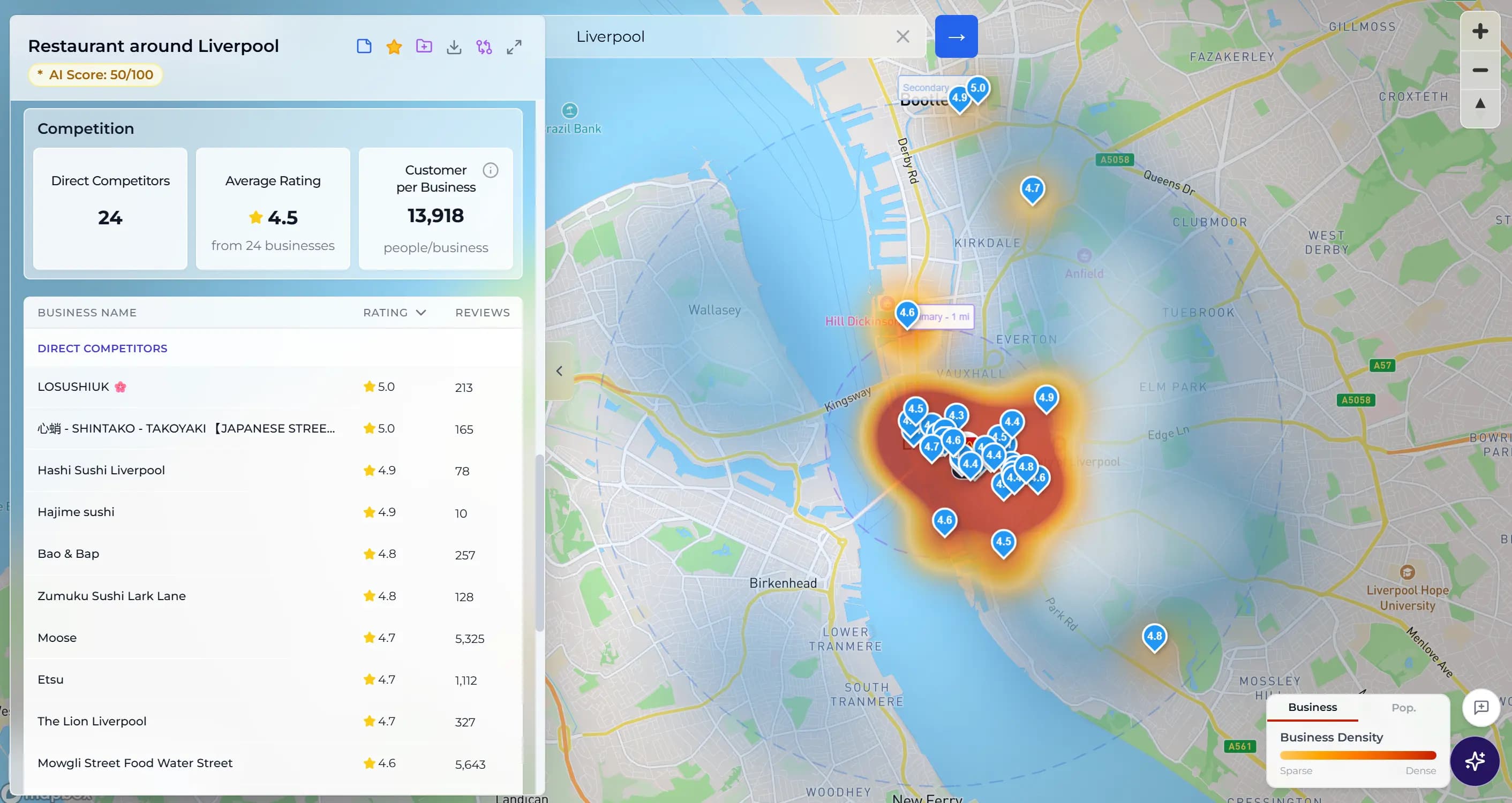
The Liverpool example above shows restaurant density, public ratings, and an estimated customers-per-business figure. That estimate divides an assumed restaurant-going share of the local population across the visible competitor set. It is directional, not a sales forecast, but it helps distinguish a busy market with headroom from one where customer demand is split across too many operators.
Separate direct and adjacent competitors
Do not monitor every place serving food. Build a direct set around the cuisine, format, price point, service model, and occasion.
A sushi restaurant may track nearby sushi operators directly, while also watching premium Asian restaurants, healthy lunch concepts, delivery-first brands, and high-rated independents competing for the same evening occasion. The adjacent set explains pressure that a category-only search can miss.
Review the set periodically. Add a relevant entrant when it appears and remove a business only when it is closed, outside the catchment, or no longer competes for the same customer decision.
Monitor reviews as movement, not a static rating
A 4.6 rating does not explain whether customer experience is improving. Track:
- Total review count and recent review velocity.
- Rating direction over a consistent period.
- Repeated positive and negative themes.
- Differences between historic reputation and recent feedback.
- Operational complaints such as waiting time, delivery, cleanliness, value, and service.
The useful question is not “who has the highest rating?” It is “who is gaining customer proof, and what are customers saying changed?”
One competitor gaining reviews quickly may indicate stronger demand, better review capture, a new opening, or a promotion. The signal should trigger investigation, not an automatic conclusion.
Add footfall and demand context
Footfall helps explain opportunity, but raw volume is not enough. A busy high street can still be a difficult restaurant market if the relevant daypart is weak or the competitor field is dense.
Compare demand evidence with:
- Weekday versus weekend patterns.
- Lunch, evening, and late-night activity.
- Nearby employment, residential, student, visitor, or transport demand.
- Competitor density within the same practical catchment.
- Review volume as a proxy for captured customer attention.
For site selection, an underserved-area analysis can highlight high-population or high-demand areas with lower visible supply. For an existing restaurant, the same comparison helps explain whether local pressure is increasing.
Watch menus, prices and offers selectively
Restaurant websites and ordering pages change often. Monitoring should focus on commercial changes:
| Change | Possible implication |
|---|---|
| New set menu or bundle | A push toward value or a new occasion |
| Lower delivery minimum | More aggressive convenience positioning |
| Extended opening hours | An attempt to capture another daypart |
| New vegan, halal or gluten-free range | A broader target audience |
| Repeated discounting | Acquisition pressure or weak full-price demand |
| Booking or collection change | A shift in operating model |
A single offer is rarely important. A sustained change in price, format, or availability is more useful.
Treat new openings and closures as research events
No monitoring system sees every opening instantly. Use regular competitor-set refreshes, local planning and licensing information, trade press, social announcements, and map searches to verify entrants.
When a relevant opening appears, capture its location, format, target customer, visible price point, hours, early review velocity, and overlap with existing catchments. When a competitor closes, avoid assuming demand disappeared. The cause may be rent, operations, ownership, or the unit itself.
Use one weekly restaurant brief
The weekly output should be short enough for an operations meeting:
- The most important competitor change.
- Reputation movement for the restaurant and its tracked set.
- A material menu, price, offer, or hours change.
- Any change to the local competitor field.
- One recommended action, test, or investigation.
This is more useful than a long feed of scraped changes. It connects outside evidence to an operating decision.
Establish your restaurant benchmark
Locus Pulse monitors physical-location markets: nearby competitors, ratings, reviews, sentiment, public offers and services, and market movement. It is designed for operators who need to understand a local trade area, not ecommerce teams tracking product prices.
Start by generating a free restaurant competitor benchmark. It gives one location a current rating and review-volume comparison against nearby same-category businesses without adding the restaurant to weekly monitoring.
Source note
Restaurant competitor monitoring in Locus uses public and availability-dependent signals such as Google Places business profiles, Google review metadata, public menu or service pages, local search rank checks, BestTime.app foot traffic context where available, and catchment evidence from the map workflow. These signals are useful for comparison and alerts, but they do not replace a restaurant's own sales, margin, lease or delivery-platform data.
Keep reading
Related guides from the Locus library.
AI-Powered Location Intelligence for Local Business Growth
How Locus brings competitor mapping, demographics, foot traffic, catchment analysis, local reputation tracking, and AI recommendations into one practical workflow.
How AI is Revolutionizing Location Intelligence for Businesses
Discover how artificial intelligence is transforming business location decisions. Learn about AI-powered site selection, predictive analytics, and automated insights.