
Restaurant Site Selection: A Data-Driven Framework
Choose the right restaurant location using demographic data, foot traffic analysis, competitor mapping, and lease economics before you sign.
Adam
Marketing Manager
Restaurant site selection is the process of evaluating candidate locations against the market conditions that drive covers, not just finding a busy street. Get it right and the site pays for itself. Get it wrong and no amount of good food recovers the economics.
Many restaurant failures trace back to location decisions made on instinct rather than data. This guide sets out the five factors that actually separate viable sites from expensive mistakes, and how to measure each one before you sign.
Why Gut Feel Keeps Getting Restaurants Into Trouble
The appeal of a location is easy to feel and hard to test. A well-lit corner unit in a busy neighbourhood looks promising in person. But "looks busy" is not the same as "attracts the right customers at the right times in sufficient numbers." Without data, you are comparing your optimism against a landlord's asking price.
The operators who make consistently good site decisions work from a structured analysis: catchment demographics, competitor density, foot traffic patterns, and unit economics, checked against each other rather than weighed separately.
Five Factors to Analyse Before You Commit
1. Catchment Demographics
Your trade area is the geography from which you will realistically draw customers, typically a 10-20 minute walk or drive depending on your concept. Within that radius, the demographic profile needs to match your offer.
For a fast-casual lunch concept, you need a daytime working population and adequate spend levels. For a neighbourhood dinner restaurant, you need residential density with the right income and age profile. Checking the postcode profile is not enough. You need to know how many people live and work within your actual catchment, what they spend on eating out, and whether demand in that category is already met.
For the wider mechanics, read our guide to trade area analysis.
2. Competitor Density
More competitors nearby is not automatically a problem. Clustering in a strong restaurant area can increase footfall to the whole street. The question is whether the market is already saturated for your specific concept.
Map every direct competitor within your catchment. Calculate how many restaurants per thousand residents you would be competing with. If the area already has six Italian restaurants for a population of 8,000, the eighth will not take business from a new market. It will split what already exists.
3. Foot Traffic Patterns
Volume of footfall matters less than timing and profile. A site with strong Saturday afternoon pedestrian traffic is ideal for casual dining; less useful for a breakfast-focused concept that needs weekday commuter flow.
Analyse foot traffic data by hour and day, not just total weekly count. Identify the peak windows and check whether they align with your service model. A site that looks high-traffic on aggregate may be quiet during exactly the hours you need to drive covers.
4. Accessibility and Visibility
Customers need to find you and reach you without friction. Check pedestrian sightlines from the main flow of foot traffic, proximity to public transport stops, and parking availability if your concept attracts car-borne diners.
A unit set back 30 metres from a busy road with poor signage lines can lose the spontaneous visit almost entirely, even if the wider area has strong demand.
5. Lease Economics Relative to Projected Revenue
A location can score well across all four factors above and still fail if the rent-to-revenue ratio is wrong. The common benchmark is rent at or below 8-10% of projected turnover for a full-service restaurant; fast-casual operators often target lower.
Model your projected weekly covers against realistic average spend and check the arithmetic before you negotiate, not after.
How to Compare a Shortlist of Sites
Once you have two or three candidate sites, score each against the same set of metrics rather than discussing them qualitatively. A simple scoring matrix surfaces the trade-offs clearly and removes the anchoring effect of whichever site you visited most recently.
Useful comparison fields include:
- Catchment population
- Competitor count
- Peak foot traffic index
- Demographic match
- Rent-to-revenue ratio
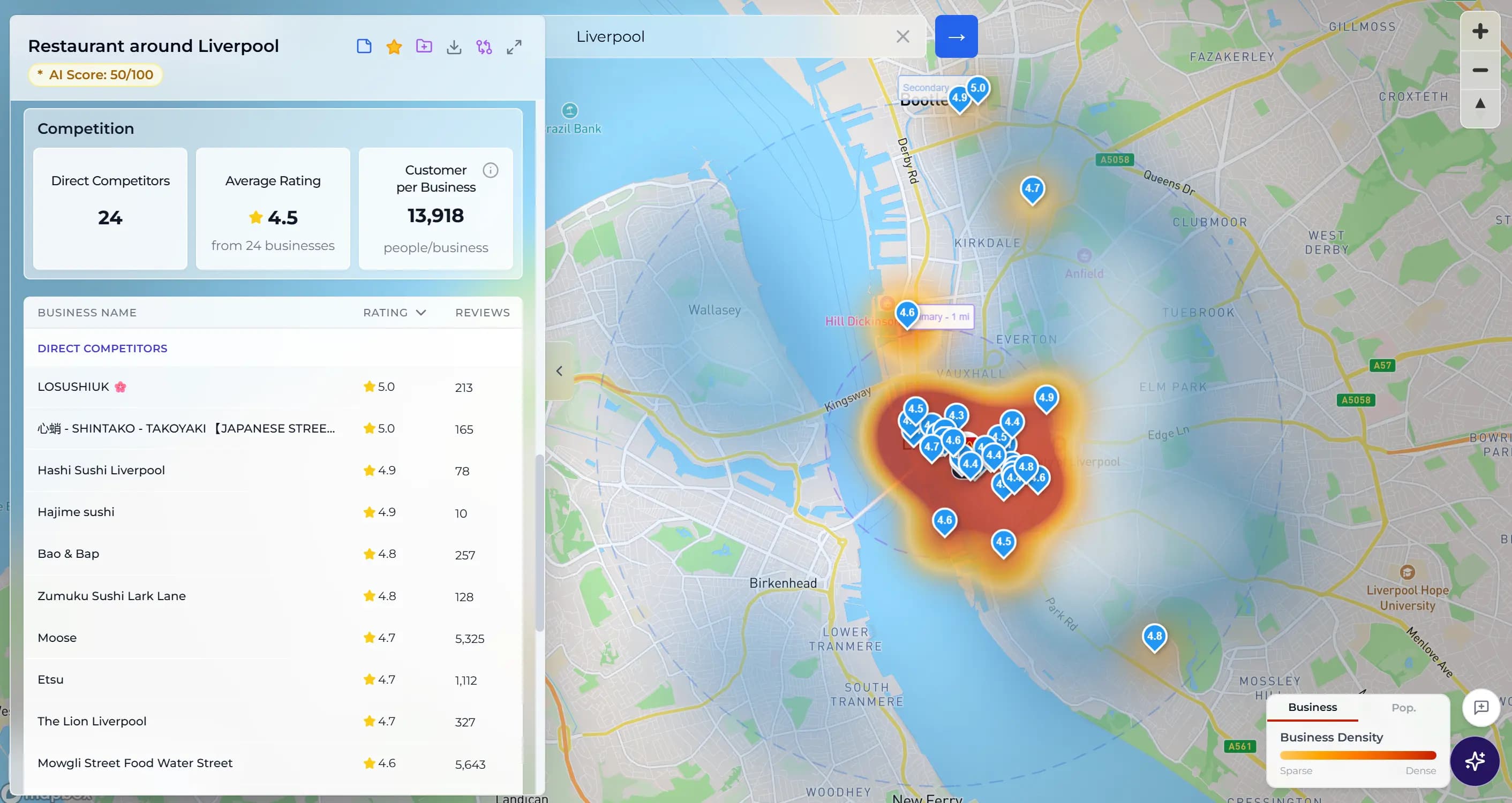
The screenshot for this article shows the same logic applied to a sushi restaurant site selection example in Liverpool. The map surfaces direct competitors, local business density, and population context in one view. It also estimates "customers per business" as a planning signal: a typical share of the local population likely to visit restaurants, divided evenly across the businesses found in the catchment. It is not a revenue forecast, but it quickly shows whether a market looks crowded or whether there may be room to expand.
In this kind of analysis, you could also switch on the underserved areas heatmap to look for pockets where population is strong but restaurant density is lower. That is useful when the question shifts from "is this site viable?" to "where else nearby could this concept expand?"
Locus automates this comparison. Run any address through the platform and get demographic data, competitor mapping, catchment sizing, and foot traffic signals in a single view. It produces a plain-English location score alongside the underlying data, so you can brief stakeholders on the analysis without building the model from scratch.
Mistakes That Recur in Restaurant Site Selection
Anchoring on the site rather than the market. A great-looking space in the wrong catchment is still the wrong catchment. Analyse the market first; shortlist properties second.
Over-weighting foot traffic without checking concept fit. A site with 50,000 weekly pedestrians is irrelevant if they are commuters passing through at 7am and your concept opens at noon.
Ignoring cannibalisation for multi-site operators. Opening a second location too close to your first splits your own customer base. Check the overlap between catchment areas before committing, especially important for franchise territory planning.
Not revisiting the analysis after lease terms change. If the landlord increases rent or the lease terms shift materially during negotiation, re-run the unit economics. The site that was viable at £45,000 per year may not be viable at £58,000.
The Bottom Line
Restaurant site selection is not about finding the busiest-looking street. It is about proving that the local demand, competitive context, foot traffic pattern, accessibility, and rent all work together.
Try Locus free - 3 searches, no card required: locusintel.io/map
Keep reading
Related guides from the Locus library.
AI-Powered Location Intelligence for Local Business Growth
How Locus brings competitor mapping, demographics, foot traffic, catchment analysis, local reputation tracking, and AI recommendations into one practical workflow.
How AI is Revolutionizing Location Intelligence for Businesses
Discover how artificial intelligence is transforming business location decisions. Learn about AI-powered site selection, predictive analytics, and automated insights.