
Trade Area Analysis Platform: What to Look For
Learn what a trade area analysis platform should show before choosing a business location, franchise territory, or CRE tenant.
Adam
Marketing Manager
A trade area analysis platform helps businesses understand where customers can realistically come from, whether local demand fits the concept, and how competition shapes the opportunity. The best platform does more than draw a radius around an address: it combines catchments, demographics, competitors, activity patterns, and site comparison into evidence you can use before signing a lease or approving a territory.
If you are choosing a location for a shop, restaurant, gym, franchise site, clinic, or tenant pitch, trade area analysis is the bridge between "this area looks busy" and "this site has enough reachable demand to justify the risk."
What is a trade area analysis platform?
A trade area analysis platform is software that defines and evaluates the geographic area a business is likely to serve. It helps teams estimate who lives, works, travels, or shops within reach of a candidate site, then compares that demand against competitors, access, foot traffic, and commercial risk. When competitor overlap is central to the decision, the next layer is competitive analysis site selection: testing whether the catchment still gives the business a clear reason to win.
Traditional trade area work often started with simple rings: one mile, three miles, five miles. That is easy to understand, but it rarely reflects how customers behave. A coffee shop might draw from a five-minute walk. A specialist furniture retailer might draw from a 30-minute drive. A gym could be shaped by commuter routes, parking, and evening residential density more than straight-line distance.
The platform's job is to make that catchment realistic enough for a business decision.
How is a trade area platform different from a map?
A map shows geography. A trade area analysis platform explains commercial reach.
That difference matters because the same address can look strong or weak depending on how the trade area is defined. A fixed-radius map may show 25,000 residents nearby, but a travel-time catchment may reveal that a railway line, dual carriageway, river, or parking constraint cuts off a large share of that demand. A competitor map may show eight nearby rivals, but a platform should help answer whether they are direct substitutes, complementary demand generators, or signs of saturation.
A useful location analytics platform connects those signals. It should move the user from "what is nearby?" to "does this place fit the decision we are making?"
What data should a trade area analysis platform include?
The strongest platforms combine several evidence layers. No single dataset is enough.
Catchment and travel-time logic
Start with the realistic customer reach. For convenience businesses, that may be a walk-time or short drive-time catchment. For destination retail, the trade area may extend further but depend on roads, parking, and competing centres. For franchise networks, the key issue may be whether a proposed site overlaps with an existing territory.
The platform should support more than one catchment view: radius, walk time, drive time, and business-type assumptions where available. It should also make the method visible. A decision-maker needs to know whether the analysis is based on a circle, a travel-time polygon, or observed customer origin data.
Demographics and customer fit
Trade area size only matters if the people inside it match the business. A premium bakery, discount retailer, family dentist, boutique gym, and quick-service restaurant each need different demographic signals.
At minimum, a platform should show population, age profile, income where available, employment, household context, and local density. In the UK, ONS Census data can support detailed local demographic analysis. In the US, Census ACS data can support tract-level analysis. Global population estimates can be useful for first-pass screening, but income and household detail may not be equally available in every market.
That source clarity is part of trust. A platform should not imply that every country has the same demographic depth.
Competitor density and market saturation
Trade area analysis should show who else is serving the same demand. Counting competitors is useful, but it is only the first layer.
A stronger platform should show direct competitors, adjacent competitors, ratings, review volume, distance, and concentration patterns. Ten coffee shops in a central commuter zone may validate demand. Ten gyms in a small residential catchment may signal saturation. For commercial real estate advisors, the same view can help match a tenant type to a unit by showing what the area lacks.
Foot traffic and activity patterns
People being nearby is not the same as people being nearby at the right time. A lunch concept needs weekday daytime activity. A cocktail bar needs evening and late-week demand. A convenience retailer may care about commuter flow, school routes, and weekend patterns.
Look for hourly or daypart-level activity signals where available. Broad "high foot traffic" labels are too blunt for lease decisions.
Site comparison and cannibalisation risk
Most serious location decisions involve alternatives. A platform should let you compare candidate sites using the same criteria, rather than building a one-off argument for whichever site has the strongest story.
For multi-location teams, cannibalisation is critical. A proposed site can look attractive on its own and still weaken the network if it overlaps heavily with an existing branch or franchisee. Trade area comparison should make that overlap visible before approval.
A practical trade area scoring framework
Use this 100-point framework when comparing sites or evaluating whether a trade area analysis platform gives you enough evidence.
| Criterion | Weight | What to check |
|---|---|---|
| Reachable demand | 25 | Catchment population, travel-time reach, daytime vs residential demand |
| Customer fit | 20 | Age, income, household, employment, and business-type match |
| Competition | 20 | Direct competitor count, quality, distance, clustering, and saturation |
| Activity and access | 20 | Foot traffic timing, parking, transit, walkability, barriers, visibility |
| Evidence quality | 15 | Source transparency, data gaps, reporting, and explainable scoring |
The weights should change by business type. A pharmacy may weight residential density and age profile more heavily. A quick-service restaurant may weight lunchtime activity and competitor clustering. A franchise network may increase the weight on cannibalisation and territory fairness.
The important point is consistency. If each site is scored differently, the comparison becomes a debate about anecdotes.
Which teams need a trade area analysis platform?
Solo founders use trade area analysis to avoid signing a lease in a catchment that does not match their customer. The decision is often personal and expensive, so the platform needs to explain the risk in plain English.
Retail and restaurant operators use it to compare sites, forecast demand quality, and avoid opening where the market is already saturated.
Franchise teams use it to define territories, protect franchisees, and make approval decisions repeatable across markets.
Commercial real estate advisors use it to support tenant recommendations. A property pitch becomes stronger when the advisor can show local demand, competitor gaps, and catchment fit rather than relying on footfall claims alone.
What should you ask before choosing a platform?
Use these questions in a vendor demo:
- Can it analyse an exact address, not just a broad postcode or city?
- Does it support radius, walk-time, drive-time, or business-type catchments?
- Which demographic sources does it use in the UK, US, and other countries?
- Can it map direct competitors and show ratings, reviews, and distance?
- Does it show activity by day or hour where available?
- Can it compare multiple candidate sites side by side?
- Can it flag cannibalisation or catchment overlap?
- Does it explain the recommendation, or only show map layers?
- Can the output be shared as a report for investors, franchisees, landlords, or clients?
- Does it make data gaps clear instead of hiding them?
If the answer to most of those questions is no, you may be looking at a mapping tool rather than a trade area analysis platform.
How Locus fits the trade area workflow
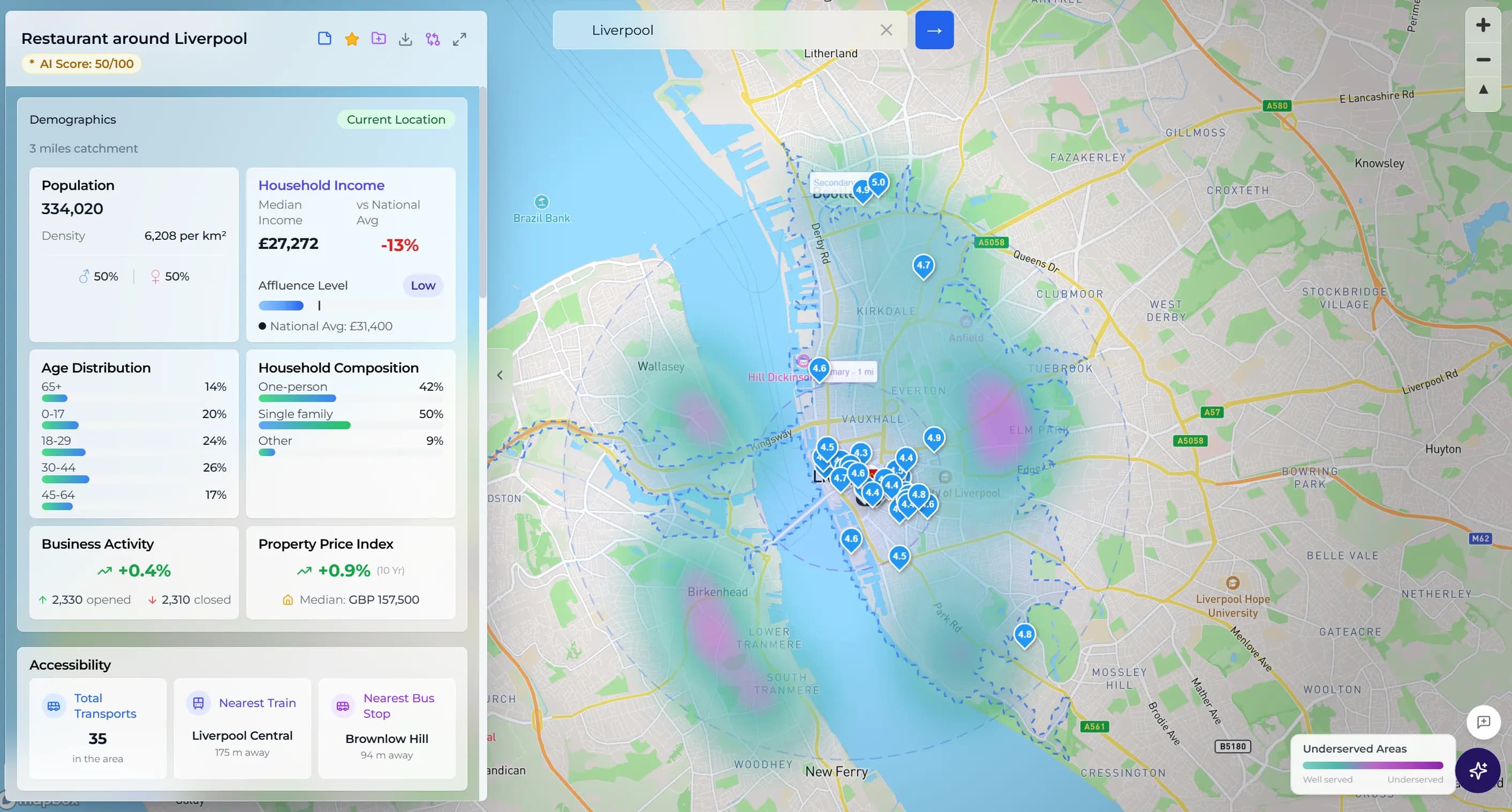
Locus is built for business location decisions rather than general GIS modelling. It combines address search, business-type catchments, competitor mapping, demographics, activity signals, site comparison, and AI-generated location assessment in one workflow.
That matters because trade area analysis is rarely useful in isolation. A catchment only becomes actionable when you can see who lives there, who competes there, when the area is active, and whether the evidence supports the decision.
For UK locations, Locus uses ONS Census data for local demographic context. For US locations, it uses Census ACS data. For wider global screening, it uses population estimates where deeper household and income fields are not available. Locus also brings in Google Places competitor data, Mapbox location and travel-time tools, BestTime.app activity data where available, and AI assessment to summarise strengths and risks.
The result is a faster first-pass decision: which sites deserve deeper diligence, which should be rejected early, and which trade area story is strong enough to share.
The bottom line
A trade area analysis platform should help you judge whether a location has enough reachable, relevant demand to support the business. It should combine catchments, commercial demographic analysis, competitors, activity patterns, site comparison, and clear reporting.
Choose full GIS if your team needs custom spatial modelling and has analysts to run it. Choose a business-ready trade area analysis platform if you need to compare real sites, explain the trade-offs, and move from local data to a defensible location decision.
Keep reading
Related guides from the Locus library.
AI-Powered Location Intelligence for Local Business Growth
How Locus brings competitor mapping, demographics, foot traffic, catchment analysis, local reputation tracking, and AI recommendations into one practical workflow.
How AI is Revolutionizing Location Intelligence for Businesses
Discover how artificial intelligence is transforming business location decisions. Learn about AI-powered site selection, predictive analytics, and automated insights.