
UK High Street Opportunity Index: The Town-Centre Coffee Component
We scored 274 GeoDS town centres across four UK nations. The result is a reproducible component, not a national league table.
Adam
Marketing Manager
A location score can be reproducible without being ready to rank the country.
This release adds a new, inspectable component to Locus's UK High Street Opportunity Index work: a coffee/cafe opportunity screen across 274 GeoDS Town Centre records. It covers England, Scotland, Wales and Northern Ireland, uses one declared peer group, and makes the source dates, category rules and sensitivity tests visible.
The useful finding is a safeguard. The data can support a four-nation town-centre scoring component, but the headline top ten is not yet a fair UK-wide ranking: all ten base-scenario leaders are in England, and the winner changes when competitive headroom or POI confidence receives a different treatment.
That is why this article publishes the component and holds the league table.
What the staged audit passed
The national universe is GeoDS Retail Centre Boundaries v4.0. The local boundary audit contains 9,623 unique UK retail centres: 8,116 in England, 811 in Scotland, 459 in Wales and 237 in Northern Ireland. Removing retail parks and shopping-centre-only classes leaves 8,404 candidates for the headline high-street screen.
The comparable demographic layer is GeoDS Unified UK Census Data 2021/2. It contains 239,023 small areas across 25 topic tables and 215 variables including table totals. England, Wales and Northern Ireland use 2021 census data; Scotland uses 2022 data. That one-year difference and the documented national-definition differences remain part of the caveat.
For current category competition, the component reuses the locally audited Overture Places release 2026-07-22.0, which was the official current release checked on 18 August before the next scheduled release. The extract contains 58,055 UK-bounding-box coffee/cafe candidates after the category and operating-status rules were applied. The rule includes cafe, coffee_shop, coffee_roastery and hong_kong_style_cafe, with open or null operating status; it excludes internet cafes, cafeterias and coffee-and-tea-supply shops.
Nomis UK Business Counts 2025 was checked as an official cross-check. It was not added to the score because its available local-unit geography is not yet equivalent to retail-centre catchments, and Northern Ireland needs an explicit treatment rather than a silent fill-in.
The local source manifest records licences, attribution, source URLs, file hashes and the exact staging order. No 2022 GeoDS centre indicators were joined to v4.0 IDs: there is no validated crosswalk in this component.
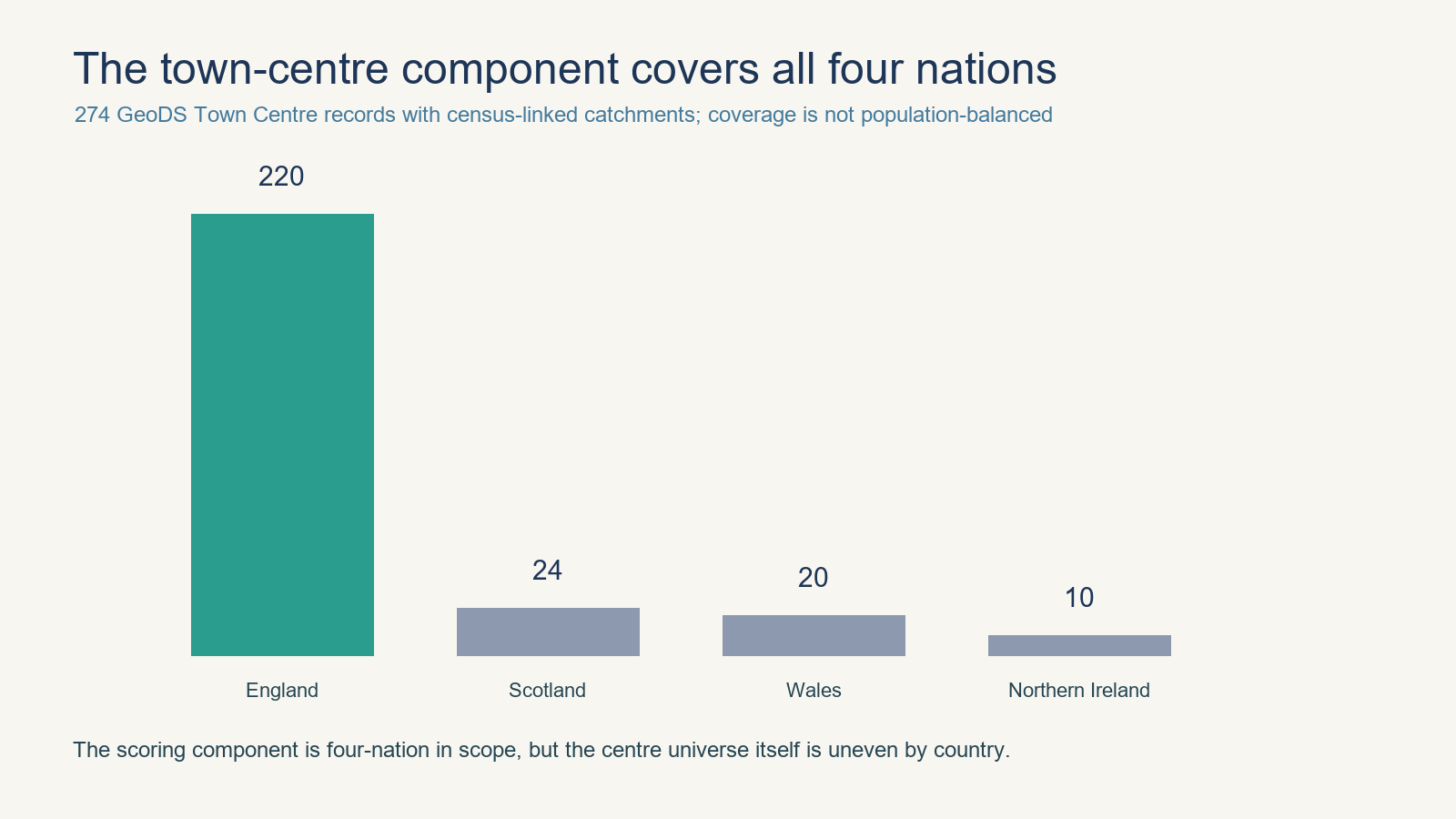
The first stage is deliberately boring but important. The feature file has 274 rows, 32 columns, no nulls in the required fields, no duplicate centre IDs and one classification: Town Centre. Every row has a census-linked catchment, and the four-nation counts are 220 England, 24 Scotland, 20 Wales and 10 Northern Ireland. This is four-nation coverage, not population-balanced representation.
How the coffee opportunity score works
The catchment is the GeoDS retail-centre polygon plus a 1 km metric buffer. Small-area census counts are allocated using the share of each small area's geometry that overlaps the catchment. The vertical pilot then uses four components, converted to percentile ranks within the 274-centre peer group before weighting:
| Component | Weight | Evidence used |
|---|---|---|
| Demand potential | 35% | Population, working-age share and relevant professional/occupation indicators |
| Competitive headroom | 30% | Catchment population per coffee/cafe POI |
| Accessibility | 20% | No-car household share as a transparent walking/public-transport proxy |
| Market resilience | 15% | Employment and professional/managerial mix indicators |
These are screening signals, not a lease recommendation. The score does not include unit rent, frontage, planning status, vacancy, footfall, brand format or the operator's execution plan.
The top-ten screen is a result, not a ranking claim
In the base scenario, Brixton leads the 274-centre screen at 94.7, narrowly ahead of Kilburn at 94.5. Tooting Graveney, Streatham Hill, Battersea and Peckham follow. All ten rows are in London or another English geography:
| Base rank | Centre | Country | Score |
|---|---|---|---|
| 1 | Brixton | England | 94.7 |
| 2 | Kilburn | England | 94.5 |
| 3 | Tooting Graveney | England | 93.2 |
| 4 | Streatham Hill | England | 93.0 |
| 5 | Battersea | England | 92.5 |
| 6 | Peckham | England | 92.5 |
| 7 | Stratford | England | 90.9 |
| 8 | Deptford | England | 89.7 |
| 9 | Wandsworth | England | 89.7 |
| 10 | Walham Green | England | 88.7 |
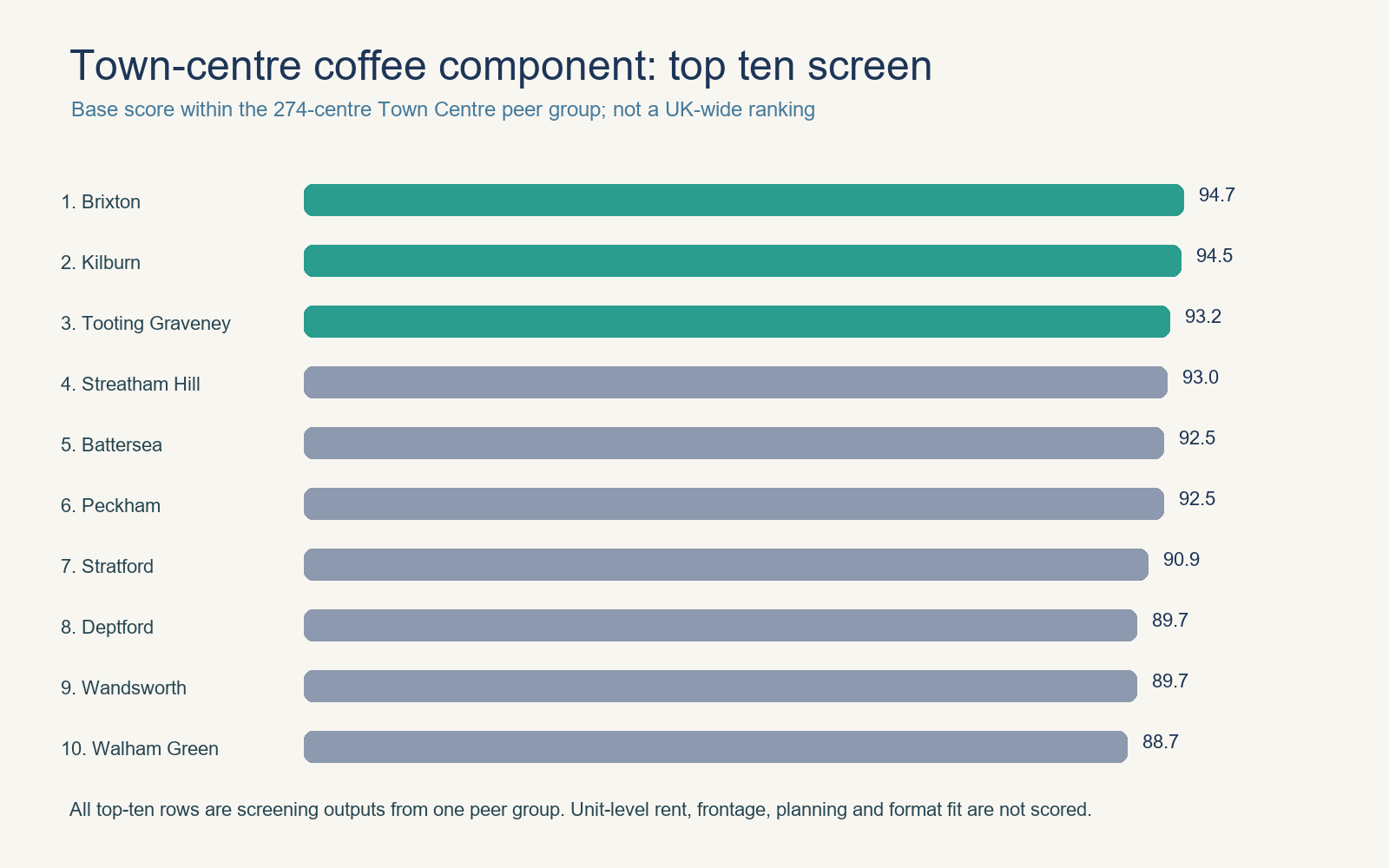
This concentration may reflect real demand, the selected peer group, the catchment construction, the POI layer or a combination of those factors. It is not evidence that England has ten objectively better coffee opportunities than the other three nations. A national claim would need stronger representation controls and another round of source validation.
The sensitivity test changes the leader
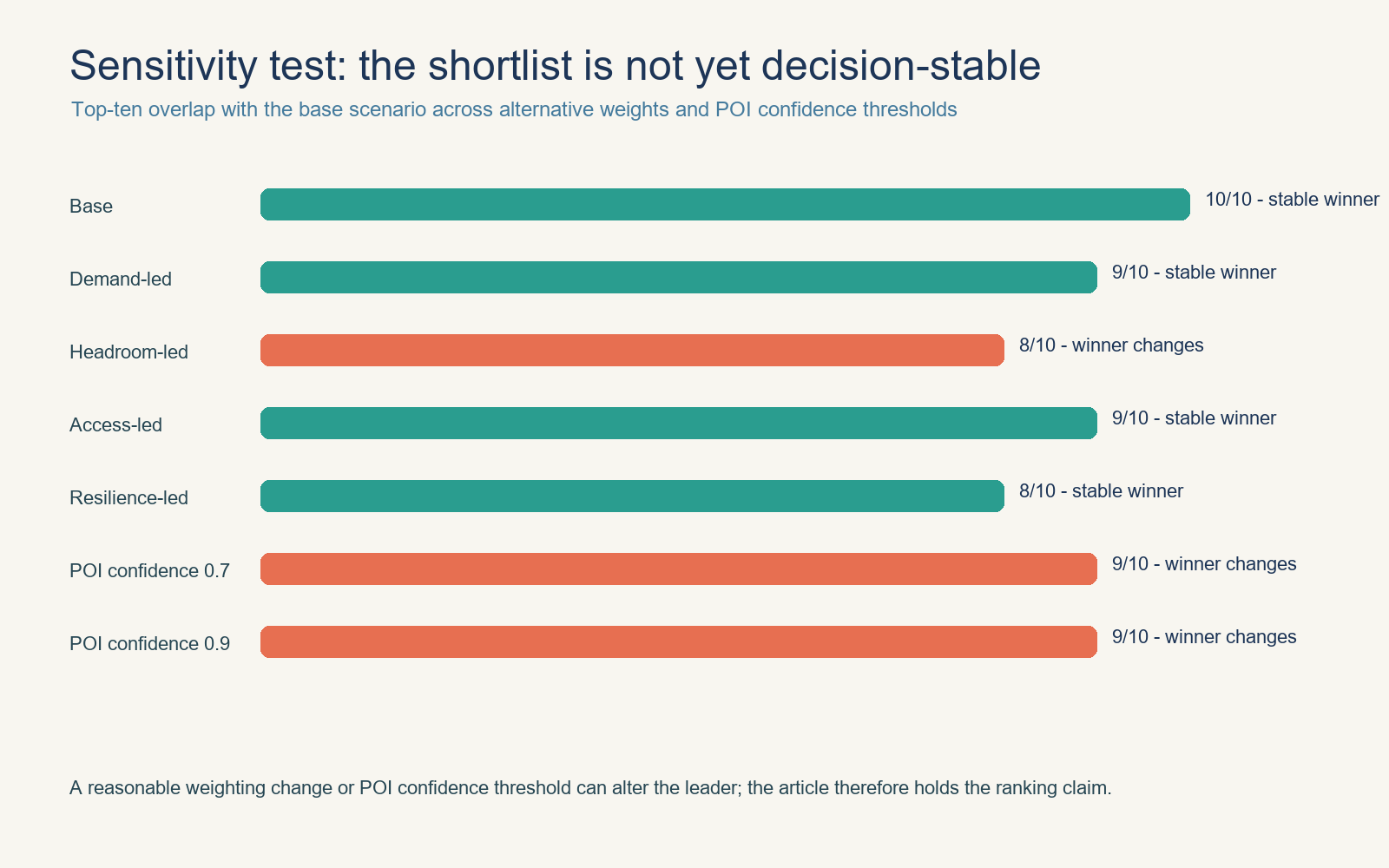
The shortlist is reasonably close to the base set, but the leader is not decision-stable. The headroom-led weighting changes the winner from Brixton to Kilburn, while the top-ten overlap falls to 8 of 10. Replacing the base POI confidence treatment with 0.7 or 0.9 thresholds also changes the winner to Kilburn, with 9 of 10 top-ten rows retained.
Demand-led and access-led scenarios keep Brixton first with 9 of 10 top-ten rows retained. The resilience-led scenario keeps Brixton first but moves some base top-ten rows by as many as seven places. Those are not catastrophic shifts, but they are material enough to keep the public ranking claim on hold.
The earlier balanced 20-centre manual pilot remains useful evidence: it sampled five centres in each nation, all 20 manual checks passed, and no score moved by more than 10 points under the pilot's alternative weights. That pilot proved the pipeline could be checked. The 274-centre component tests what happens when the same logic is applied to a larger peer group. The answer is not yet a national winner; it is a clear next validation task.
What this means for operators and property teams
For a coffee operator or franchise expansion team, the component is a screen for where to investigate next. It is not a substitute for checking the actual unit.
The practical sequence is:
- Compare centres inside a declared format and peer group.
- Check whether the result survives reasonable changes to weights and POI confidence.
- Inspect the specific catchment, access route, direct competitors and customer profile.
- Validate the unit's rent, frontage, planning constraints, visibility and operating format.
For CRE and property advisers, the same discipline makes a shortlist easier to defend. Show the comparison universe, the source dates and the proxies. Separate measured evidence from modelled score components. If a ranking changes when a reasonable assumption changes, show that before the client treats the list as settled.
Keep reading
Related guides from the Locus library.
AI-Powered Location Intelligence for Local Business Growth
How Locus brings competitor mapping, demographics, foot traffic, catchment analysis, local reputation tracking, and AI recommendations into one practical workflow.
How AI is Revolutionizing Location Intelligence for Businesses
Discover how artificial intelligence is transforming business location decisions. Learn about AI-powered site selection, predictive analytics, and automated insights.