
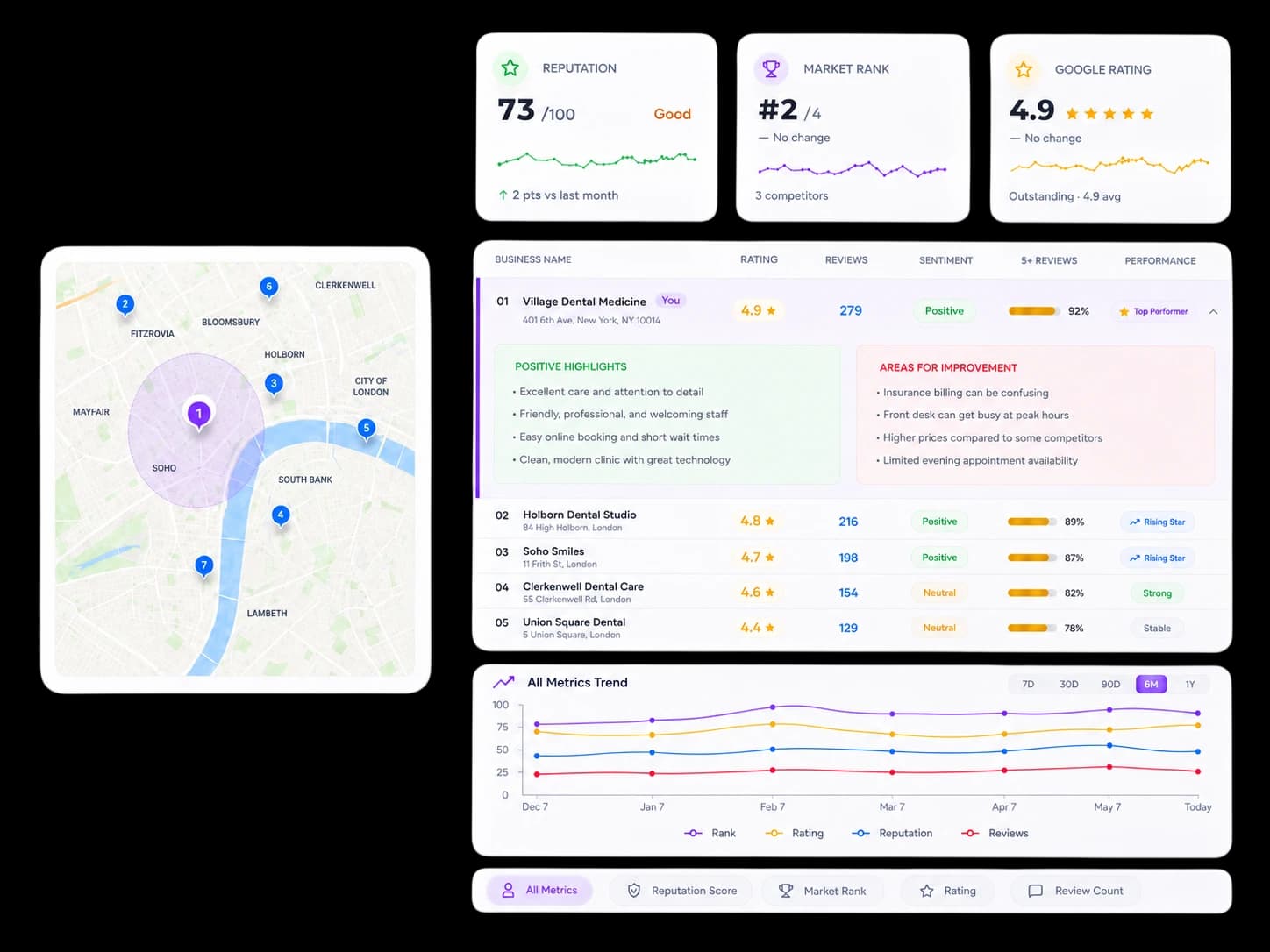
How to Monitor Local Competitors Without Checking Google Maps Every Week
A practical local competitor-monitoring workflow for tracking reviews, rankings, offers, services, and market movement across physical locations.
Adam
Marketing Manager
Local competitor monitoring means recording the same useful signals for the same nearby businesses over time: ratings, review volume, review sentiment, local rank, services, prices, offers, opening hours, and other public commercial changes. The aim is not to collect more screenshots. It is to notice a meaningful change early enough to act.
Google Maps is excellent for discovering who is nearby. It is less useful as a repeatable monitoring system. A manual check rarely uses the same competitor set, radius, date, or scoring method twice. That makes week-to-week comparisons unreliable, especially when a team manages several locations.
Why manual checks break down
A typical competitor check starts with a map search, a few profile tabs, and a spreadsheet. That can work for one location. It becomes fragile when the job repeats.
- The person checking may search a different phrase or radius.
- The visible map results can change by device, location, and query.
- Review counts are copied without the previous figure beside them.
- Website changes are noticed only when someone remembers the old page.
- Several locations create several slightly different spreadsheets.
The problem is not access to information. Most of the signals are public. The problem is maintaining a consistent baseline.
Start with a fixed local competitor set
Define the market before tracking it. Use a clear business category, a practical catchment, and a shortlist of direct and adjacent competitors.
For a neighbourhood coffee shop, the direct set may include cafes and specialty coffee operators within a walkable catchment. Adjacent competition could include bakeries, hotel lounges, and quick-service venues that compete for the same morning purchase. For a dental practice, the useful catchment and competitor set will be different.
Competitor proximity analysis is the best starting point because it separates a genuine local market from a loose list of businesses in the same city.
Track signals that can change a decision
Not every visible change deserves an alert. Focus on evidence connected to customer choice or commercial pressure.
| Signal | What to record | Why it matters |
|---|---|---|
| Reviews | Rating, total reviews, recent review themes | Shows reputation direction and customer friction |
| Local position | Rank within the tracked market | Reveals whether relative visibility is improving or slipping |
| Offer | Services, menu, packages and positioning | Shows how competitors are changing what customers can buy |
| Price | Public prices and promotions where available | Helps explain changes in value perception |
| Operations | Hours, booking, delivery or collection | Identifies changes in convenience and availability |
| Market set | Relevant entrants, closures or exclusions | Keeps the comparison representative |
Website monitoring should ignore cosmetic edits. A changed footer or tracking script is noise. A new treatment, lower lunch price, extended opening time, or delivery option can affect customer behaviour.
Use a weekly exception report
A useful monitoring workflow should not ask a manager to reread every profile. It should surface exceptions:
- Which competitor gained reviews faster than usual?
- Did sentiment improve or weaken around a specific theme?
- Has a competitor changed a service, price, menu, offer, or booking option?
- Has your business moved relative to the same local set?
- Does the change require an action, further investigation, or no response?
This keeps the process operational. Stable signals remain available, but attention goes to the few changes worth discussing.
Compare locations on the same basis
Multi-location teams need a common vocabulary. One location may face strong reputation pressure while another faces an offer or visibility problem. A shared benchmark makes those differences easier to see.
Use the same core measures across locations, then keep category-specific evidence where it matters. A restaurant team may care about menu, delivery, offers, and evening review themes. A fitness operator may care about class formats, joining offers, opening hours, and member complaints.
The point is not to force every location into one score. It is to make each local market comparable enough to decide where attention is needed.
Turn a change into an action
Monitoring has no value if it ends with a dashboard notification. Each material change should lead to one of four outcomes:
- Respond: fix a clear weakness or sharpen an offer.
- Test: run a small local change before copying a competitor.
- Investigate: verify whether the public signal reflects a real market shift.
- Ignore: record the change but take no action because it is not commercially important.
Avoid copying every competitor move. The best response may be to protect a point of difference rather than match a discount or service.
A simpler way to establish the baseline
Locus Pulse is built for physical-location competition rather than ecommerce price scraping. It keeps nearby competitors, reviews, public website changes, market position, and local evidence in one monitoring workflow.
You can generate a free local competitor benchmark before adding a business to monitoring. It compares the current Google rating and review volume for one business against nearby same-category competitors, giving you a practical baseline without another weekly spreadsheet.
Source note
This workflow is based on public local-market signals that Locus can collect or structure for monitored businesses: Google Places competitor profiles, public Google review metadata, public competitor-owned website pages, local search ranking checks via DataForSEO, and Locus catchment context. Ratings, reviews, prices, services, offers and opening hours can change after collection, so a benchmark should be treated as a dated market snapshot rather than a permanent score.
Keep reading
Related guides from the Locus library.
AI-Powered Location Intelligence for Local Business Growth
How Locus brings competitor mapping, demographics, foot traffic, catchment analysis, local reputation tracking, and AI recommendations into one practical workflow.
How AI is Revolutionizing Location Intelligence for Businesses
Discover how artificial intelligence is transforming business location decisions. Learn about AI-powered site selection, predictive analytics, and automated insights.