
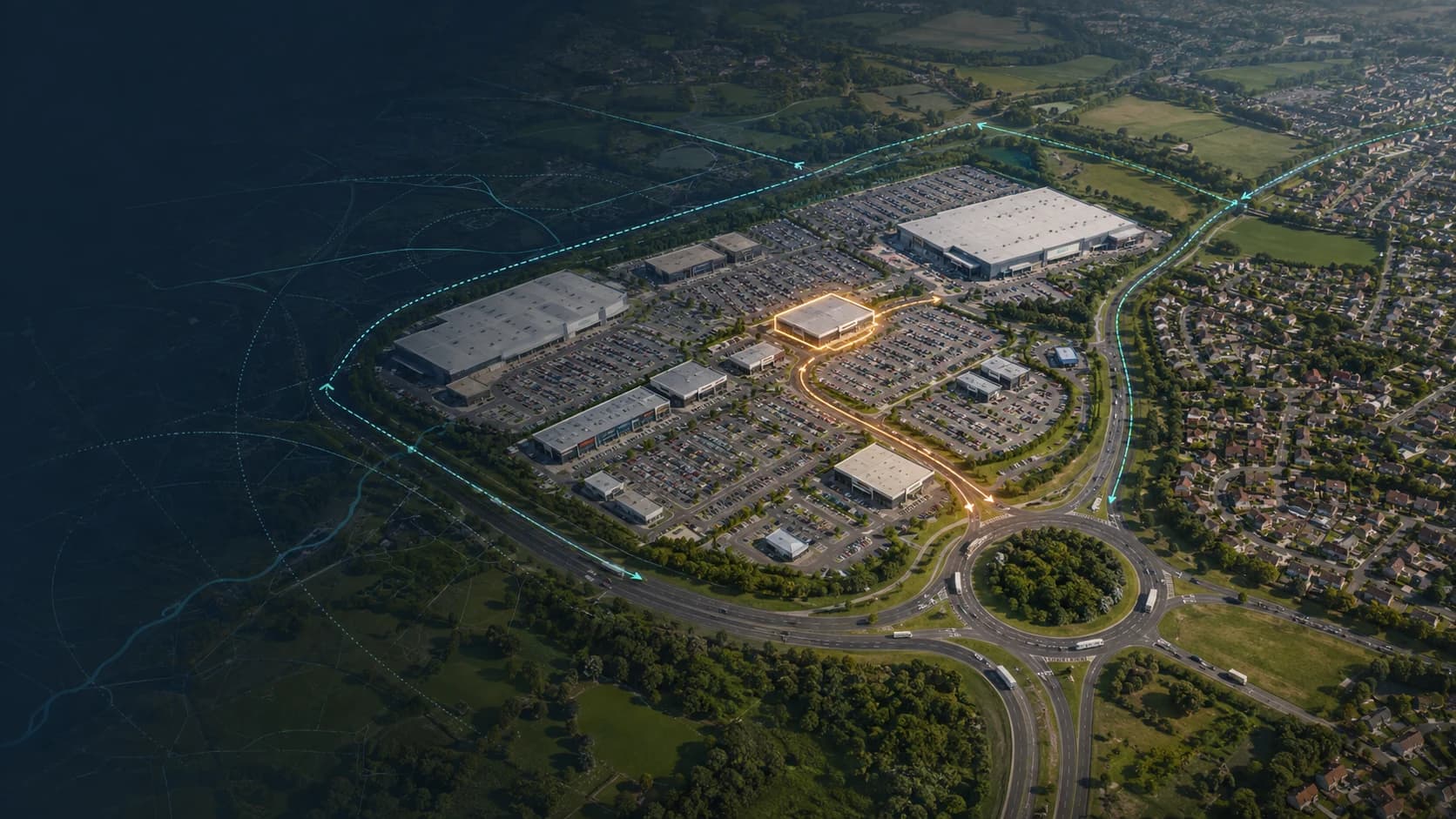
Retail Park Site Selection: A Practical Framework
A practical retail park site-selection framework for comparing catchment, customer fit, anchors, access, competition and evidence quality.
Ahmed
Founder of Locus
Retail park site selection is the process of comparing an out-of-town or edge-of-town retail destination on realistic catchment, customer fit, access, anchor and co-tenancy context, competition, activity timing and commercial constraints before choosing a unit. In the UK, the screen should start with the park's reachable market and tenant mix, then test the specific unit; Locus can connect demographic, catchment, business and activity evidence while planning, lease and site-visit diligence remain separate.
Why is a retail park a different site-selection problem?
A high street often depends on walk-by visibility, short visits and a dense sequence of frontages. A retail park is more often a destination system: customers may drive, make several stops, use a shared car park and decide whether the whole trip is worth making. That changes the questions a team should ask.
The destination needs enough relevant demand to justify the journey. The individual unit then needs a useful position inside that destination: clear access, workable visibility, practical servicing, suitable neighbours and an offer that benefits from the existing trip mission. A strong anchor can help, but an anchor is not a guarantee that every unit receives the same customer flow.
This is a two-stage decision. First ask whether the retail park is a credible market for the concept. Then ask whether the proposed unit can capture enough of that market without being hidden, inaccessible or commercially unworkable.
What should the first retail-park screen measure?
1. Customer fit in the reachable market
Start with the people who can realistically reach the destination, not the population of the nearest local authority. For UK work, ONS Census data provides population, age, household, employment, income and housing context at small-area geographies. Locus uses UK MSOA-level demographic data where available, so the output is a screening view rather than a street-level guarantee.
Translate the concept into a customer question. A bulky-goods retailer may need a wider drive-time market and household or income fit. A convenience-led format may depend more on nearby residents and repeat trips. A specialist fashion or leisure offer may need a wider destination pull and the right complementary tenants.
2. Realistic drive-time reach
A circle is useful for a quick comparison, but it does not show how a customer actually arrives. Compare a radius with a travel-time catchment using the road network and the relevant mode. The Mapbox Isochrone API is one example of how travel time can reveal barriers that a straight-line ring misses.
Look for motorways, rivers, rail lines, junctions, one-way systems and difficult turns. A retail park with a large theoretical population may have a much smaller practical market if the final approach is confusing or congested. Test the same travel-time settings across candidates so the comparison remains fair.
3. Anchors, co-tenants and direct competition
Map the businesses that shape the trip. The Google Places API can provide nearby names, categories, ratings, review counts and locations for a competitor and co-tenancy discovery layer. Use the results as evidence to inspect, not as a perfect tenant register: category labels vary and dense areas can exceed a single nearby-search response.
Separate three roles:
- Anchors that may attract a broad trip or provide a strong reason to visit.
- Complementary co-tenants that make the journey more useful for the target customer.
- Direct competitors that compete for the same need, wallet and visit occasion.
Competitors are not automatically negative. Clustering can confirm demand and create comparison-shopping behaviour. The right question is whether the proposed unit has a credible reason to win within the cluster.
4. Activity and daypart fit
Activity must be matched to the store's operating model. A relative busyness pattern from BestTime.app may help show when supported venues are more or less active, but it is not an exact count of every passer-by, vehicle or store entry. Coverage is not universal, so an unavailable signal must not be treated as zero demand.
Compare weekday, weekend and trading-hour patterns. A retail park that is strong on Saturday but weak during the proposed weekday schedule may be a poor fit for a convenience or service-led concept. Conversely, a destination format may accept lower frequency if the catchment, trip purpose and basket economics work.
5. Unit-level access and commercial constraints
Location data can narrow the question, but it cannot confirm every property fact. Verify signage, visibility from the relevant approach, pedestrian routes from parking, loading access, servicing hours, unit size, planning use, rates, rent, service charge, fit-out requirements and lease terms with the relevant property and legal sources.
The key is to keep those facts visible in the decision record. A site can score well on market evidence and still fail because the unit cannot support the format or because the lease economics are wrong.
How do you compare retail park candidates?
Use the same sequence for each destination and each unit:
- Define the format and decision stage. Record the concept, trading hours, customer mission, required unit size, service needs and whether the decision is market entry, shortlist, viewing or lease approval.
- Screen the destination. Compare reachable demographics, travel-time access, business density, anchor/co-tenant context, competition and activity patterns. Reject a park that fails a non-negotiable condition before spending time on unit-level diligence.
- Test the unit inside the park. Inspect frontage, approach routes, parking-to-door movement, visibility, neighbouring uses, servicing and practical customer friction. Use the same catchment settings and comparison criteria across units.
- Check the daypart and trip mission. Ask when the park is active and whether that activity matches the concept. Do not use a headline weekend observation as a proxy for all trading periods.
- Write the recommendation with uncertainty. State which evidence supports advancing the unit, what remains unknown and what must be checked on site or in the lease pack. A shortlist is stronger when its assumptions are explicit.
For the broader method, the retail site-selection guide explains how customer profile, catchment, competition and commercial requirements fit together. The park-specific layer here adds destination structure and shared-access questions rather than creating a separate scoring formula.
What is a practical 100-point scorecard?
Use a scorecard to make trade-offs visible, not to imply that every retail concept has the same economics:
| Dimension | Weight | What to test |
|---|---|---|
| Customer and market fit | 20 | Reachable demographics, customer mission and format fit |
| Travel-time reach | 20 | Drive-time access, barriers and realistic catchment shape |
| Anchor and co-tenancy value | 15 | Relevant trip generators and complementary uses |
| Competitive context | 15 | Direct rivals, clustering, differentiation and overlap |
| Access and unit visibility | 15 | Approach, parking-to-door route, signage and frontage |
| Activity and daypart fit | 10 | Available activity evidence during the proposed trading window |
| Evidence quality | 5 | Recency, coverage, definitions and unresolved assumptions |
| Total | 100 |
Imagine two units with similar rent. Park A has a larger nearby population and a famous anchor, but one difficult approach, weak weekday activity and several direct competitors. Park B has a smaller headline population, but two straightforward arrival routes, better customer fit, complementary tenants and stronger evidence coverage. An illustrative score might place Park A at 71/100 and Park B at 83/100—not because the model predicts revenue, but because it makes the access, fit and evidence trade-offs visible.
Change the weights for the concept, then keep them stable across the shortlist. Record the source and confidence for each score. If a score depends on an assumption that a site visit or lease pack has not verified, mark it as provisional rather than hiding the uncertainty inside a single total.
What mistakes weaken a retail park decision?
- Using a default radius for every concept. A 10-minute drive may be useful for one format and misleading for another. Define the customer mission first.
- Treating anchors as guaranteed unit traffic. An anchor can attract a trip without sending customers past the proposed frontage.
- Counting every competitor as a reason to reject. Clusters can create demand; the issue is whether the offer can compete and be found.
- Inferring parking and visibility from a map. Check the final approach, pedestrian route, signage and barriers in person.
- Calling a proxy a forecast. Relative busyness, demographic fit and competitor counts are decision inputs, not guaranteed sales or market share.
- Ignoring the unit after approving the destination. A good park can still contain a poor unit. Keep destination and unit decisions separate.
How can Locus support retail park screening?
Locus gives a retail or CRE team one place to inspect a candidate address, compare catchment views, review demographic context, map nearby businesses and competitors, and examine available activity signals. Depending on plan and coverage, the workflow can add heatmaps, travel-time overlays, multi-location comparison, an AI location assessment and a report that makes the underlying evidence easier to discuss.
That workflow is useful before a viewing or lease conversation because it standardises the first screen. A team can ask the same questions of every park: who can reach it, when is the destination active, which tenants shape the trip, where are the direct competitors and which assumptions still need field verification? The location analytics platform guide explains how connected evidence supports this wider decision workflow.
Locus does not replace planning checks, landlord information, traffic surveys, lease review, legal diligence or an on-site visit. It helps focus those expensive steps on the destinations and units that have earned closer attention.
Frequently Asked Questions
What is retail park site selection?
It is the process of comparing out-of-town or edge-of-town retail destinations and individual units on reachable demand, customer fit, access, tenant mix, competition, activity timing and commercial viability.
How large should a retail park catchment be?
There is no universal size. Set the catchment from the format, customer mission, travel mode and expected visit frequency, then compare candidates using the same radius and travel-time assumptions.
Are retail parks better than high streets?
Neither is automatically better. Retail parks may suit car-led, destination or bulky-goods missions, while high streets may suit walk-in, public-transport and dense mixed-use demand. The right choice depends on the concept and its customer journey.
Are anchors always good for a retail unit?
No. An anchor can create a reason to visit, but the benefit depends on route visibility, complementary tenants, customer overlap, parking movement and whether shoppers pass the unit.
Can Locus predict retail park sales?
No. Locus can organise location evidence and produce an AI-assisted assessment, but activity proxies, demographic context and competitor data are not a sales forecast. Validate the commercial case with trading assumptions, property diligence and on-site evidence.
Sources and limitations
This framework uses ONS Census for UK demographic context, Mapbox Isochrone documentation for travel-time catchment concepts, Google Places documentation for business and competitor discovery, and BestTime.app for the relative busyness signal referenced in the workflow. Source coverage, freshness and definitions vary by location. No score in this guide is a market ranking, revenue forecast or substitute for property and legal diligence.
Analyse any location in Locus → Start with the Locus location workflow
Keep reading
Related guides from the Locus library.
AI-Powered Location Intelligence for Local Business Growth
How Locus brings competitor mapping, demographics, foot traffic, catchment analysis, local reputation tracking, and AI recommendations into one practical workflow.
How AI is Revolutionizing Location Intelligence for Businesses
Discover how artificial intelligence is transforming business location decisions. Learn about AI-powered site selection, predictive analytics, and automated insights.