
Retail Site Selection: A Practical Data-Driven Guide
Choose the right retail location using trade area analysis, demographic data, competitor mapping, and lease economics before you sign.
Adam
Marketing Manager
Retail site selection is the process of identifying which locations give your business the best chance of succeeding, based on data rather than instinct. Get it right and foot traffic, revenue, and brand visibility follow. Get it wrong and a five-year lease becomes an expensive lesson.
Before choosing a retail store location, check five things in order: customer fit, trade area reach, foot traffic pattern, competitor density, and lease economics. A strong site should have enough of the right customers, practical access, manageable competition, and a rent level the local demand can support.
This guide covers the five factors that matter most, and how to evaluate each one before you commit. A dedicated location analytics platform can bring those signals into one workflow instead of leaving your team to stitch together maps, spreadsheets, and separate data sources.
What Is Retail Site Selection?
Retail site selection is the structured process of evaluating candidate locations against your target customer profile, competitive environment, and commercial requirements. It has historically involved spreadsheets, census reports, and educated guesses. Today it uses location intelligence: mapping demographic data, foot traffic signals, competitor density, and catchment analysis into a single decision.
The goal is not just picking a busy street. It is finding the specific intersection of strong demand, manageable competition, and a reachable customer base.
The Five Factors That Drive Retail Location Decisions
1. Demographics
Who lives, works, and travels through the area? Age, income, household size, and lifestyle profile all determine whether local demand matches your offer. A premium homeware brand and a discount grocer have very different demographic requirements, even if both need "high foot traffic."
Demographic analysis for your target location should look beyond a single radius. Commuter flows, daytime population, and residential density within a realistic travel time give a more accurate picture than a simple postcode lookup.
2. Trade Area and Catchment
Your trade area is the geographic zone from which you will draw the majority of your customers. Defining it correctly is critical. Underestimate it and you may overestimate how many sites can sustain your business.
Understanding your trade area means modelling drive times, walk times, and transit catchment rather than drawing a circle on a map.
A good catchment analysis also flags cannibalisation risk: how much does this candidate site overlap with any existing locations in your portfolio?
3. Foot Traffic and Accessibility
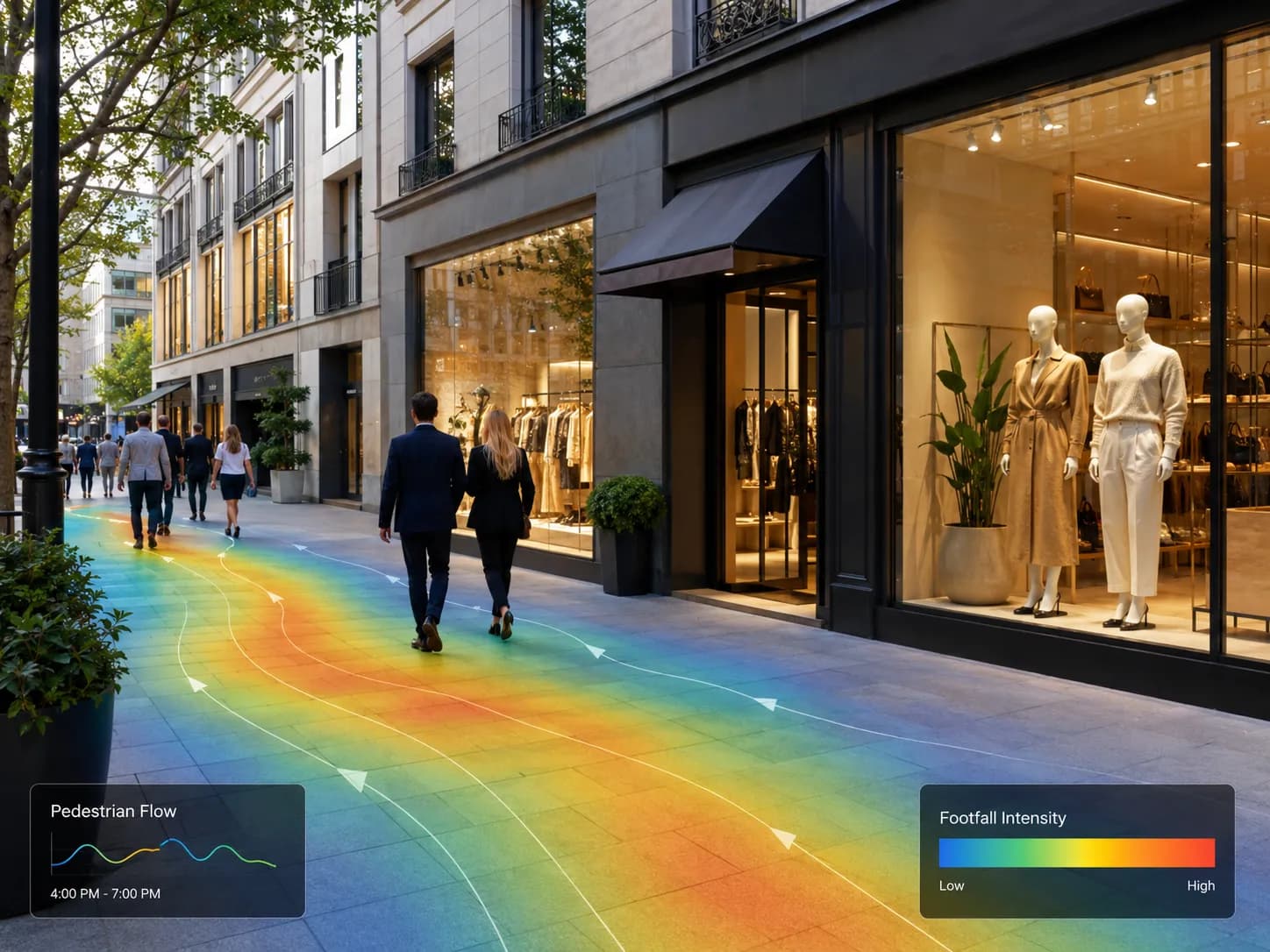
Footfall data tells you how many people move through an area, when, and from which direction. High street numbers mean little if most pedestrians pass on the opposite side of the road. Accessibility, including car parking, public transport proximity, and cycle routes, determines how many of those passersby can actually reach your door.
For retailers dependent on impulse or convenience visits, foot traffic is often the single most predictive variable. For destination retailers such as furniture, specialist, or high-consideration purchases, the catchment radius and demographic profile matter more than raw footfall counts.
4. Competitive Density
How many similar businesses are already operating within your trade area? A saturated market means fighting for a fixed customer base. Whitespace, or a gap in competitor provision where demand exists but supply does not, is where new locations consistently outperform expectations.
The subtler question is whether competition generates demand or dilutes it. A cluster of coffee shops on a high street often performs better than one isolated unit. A fourth gym in a single neighbourhood rarely does. Mapping competitor locations alongside their estimated trade areas gives you a much clearer read than simply counting pins on a map.
5. Lease Economics and Site Viability
Location quality and lease economics are not the same thing. The best-performing catchment in a city is useless if the rent-to-revenue ratio does not work. Before committing to any site, model the realistic footfall-to-conversion rate, your average transaction value, and whether achievable revenue supports your total occupancy cost.
This is also where exit risk matters. A long lease on a marginal site, one that looks acceptable today but lacks growth headroom, is the most common expensive mistake in retail property decisions.
Why AI Is Changing Retail Site Selection
Historically, combining all five factors required separate data sources, weeks of analysis, and a real estate advisor experienced enough to synthesise them. AI-powered location intelligence platforms now run the full analysis in minutes: demographic profiling, catchment modelling, competitor density scoring, and site comparison, with plain-English decision notes that non-specialists can actually use.
The practical benefit is not speed alone. It is consistency. Every site on your shortlist gets evaluated against the same criteria, removing the bias that creeps in when one candidate location has a better story than another.
Validate Before You Sign
Good retail site selection does not end with a shortlist. It ends when you can defend the decision with data. That means comparing multiple candidates on equal terms, pressure-testing assumptions about catchment and demand, and stress-testing the financials before the lease is on the table.
Analyse any location in Locus: locusintel.io/map
Keep reading
Related guides from the Locus library.
AI-Powered Location Intelligence for Local Business Growth
How Locus brings competitor mapping, demographics, foot traffic, catchment analysis, local reputation tracking, and AI recommendations into one practical workflow.
How AI is Revolutionizing Location Intelligence for Businesses
Discover how artificial intelligence is transforming business location decisions. Learn about AI-powered site selection, predictive analytics, and automated insights.