

Austin Fast-Casual Restaurant Site Selection: Strong Catchment, Tougher Competition
A Locus screen of central Austin finds strong demographics and access for a fast-casual concept, but enough competitive pressure to make frontage and fieldwork decisive.
Ahmed
Founder of Locus
Where should a fast-casual restaurant look first in Austin? The useful answer is not a city-wide verdict. It is a narrower decision: does a specific catchment offer enough people, access and occasion variety to justify checking a real frontage, and what would the operator have to beat?
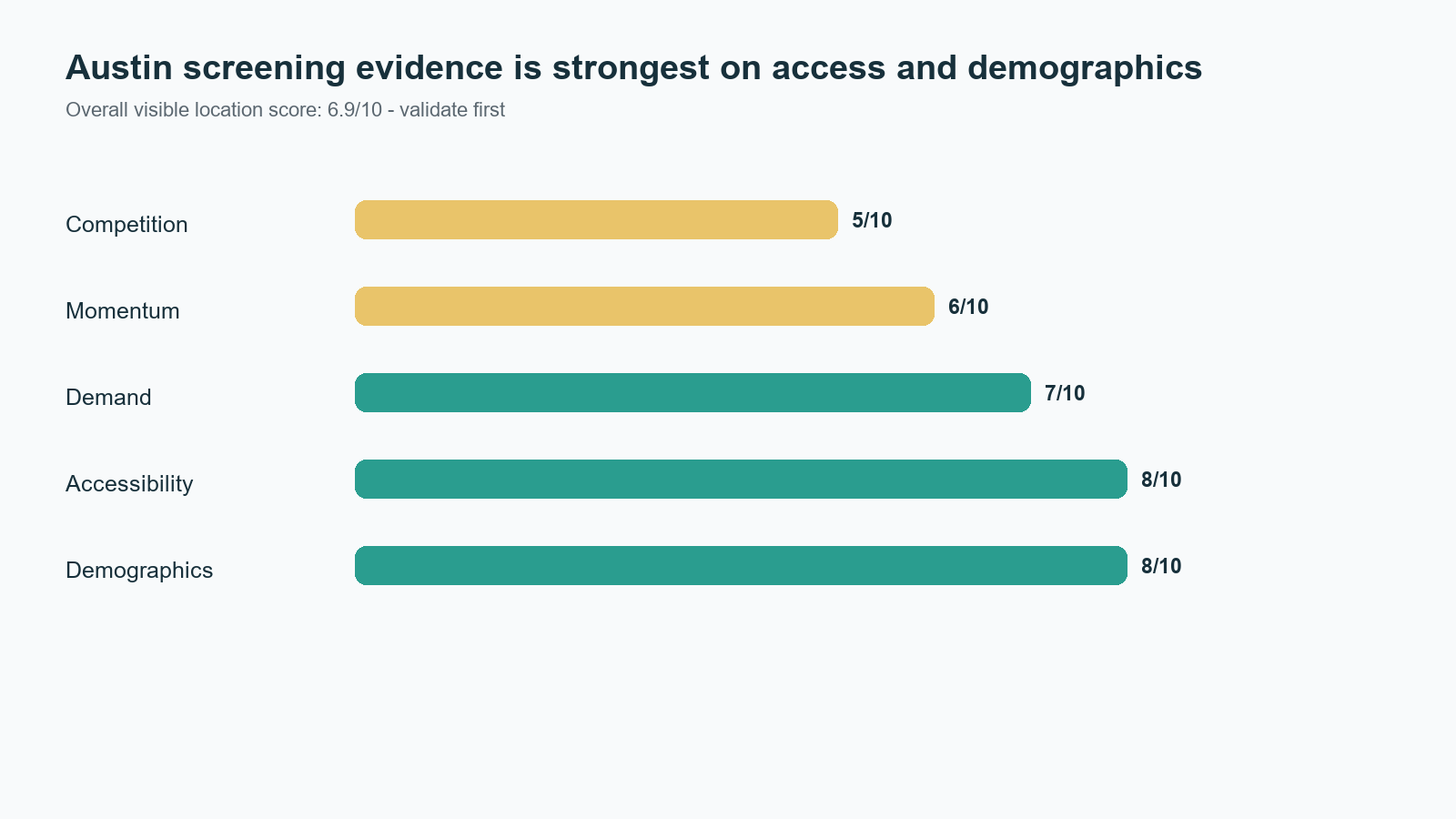
To make that decision concrete, I ran an authenticated Locus screen around central Austin using a Fast casual Restaurant focus and a three-mile catchment. The screen produced a 6.9/10 location assessment. That is strong enough for a shortlist, but not strong enough to skip site visits, competitor checks or unit economics.

The method
The study recorded the values visible in Locus on 20 September 2026. The workflow combined catchment demographics, access, demand signals, nearby points of interest, a direct-competitor table and a location assessment. The same three-mile catchment was used throughout the screen.
The visible score combines evidence across demographics, accessibility, competition, demand and market momentum. It is a screening aid. It does not forecast revenue, measure pedestrian counts, rank vacant units or recommend a lease. Competitor discovery and profile metrics are Google Places-backed signals surfaced by Locus; the underlying provider payload was not independently refetched for this article.
The catchment has the ingredients for a serious shortlist
The displayed catchment contained 150,291 people at a density of 2,977 per square kilometre. Median household income was $94,652, compared with a displayed national average of $75,149. The 18–44 groups made up 62% of the displayed age distribution, and one-person households represented 67%.
That combination creates a plausible fast-casual customer case: a large urban catchment, high relative income and a substantial young-adult and working-age audience. It still does not answer the operating question. A concept has to convert that broad potential into visits at one frontage, at the right dayparts and at a price the catchment will accept.
Access was another strength. The screen showed 25 transport locations, a train reference 1.4 kilometres away and a bus stop 374 metres away. The assessment displayed Walk, Bike and Transit Scores of 81, 83 and 61, with 14 transit stops within 500 metres. For a fast-casual operator, that makes the exact pedestrian approach and lunchtime path more important than a simple “central Austin” label.
Demand is promising, but the signal is not a footfall count
The demand panel showed weekends as 1.2 times busier, afternoon as the peak period, 61% average occupancy and an average visit of 52 minutes. The displayed broad keyword signal was 60,500 monthly searches with a 47% increase over three years. The weekly relative activity profile was strongest on Saturday at 49 and Friday at 47, with Tuesday and Wednesday lower at 34 and 28.
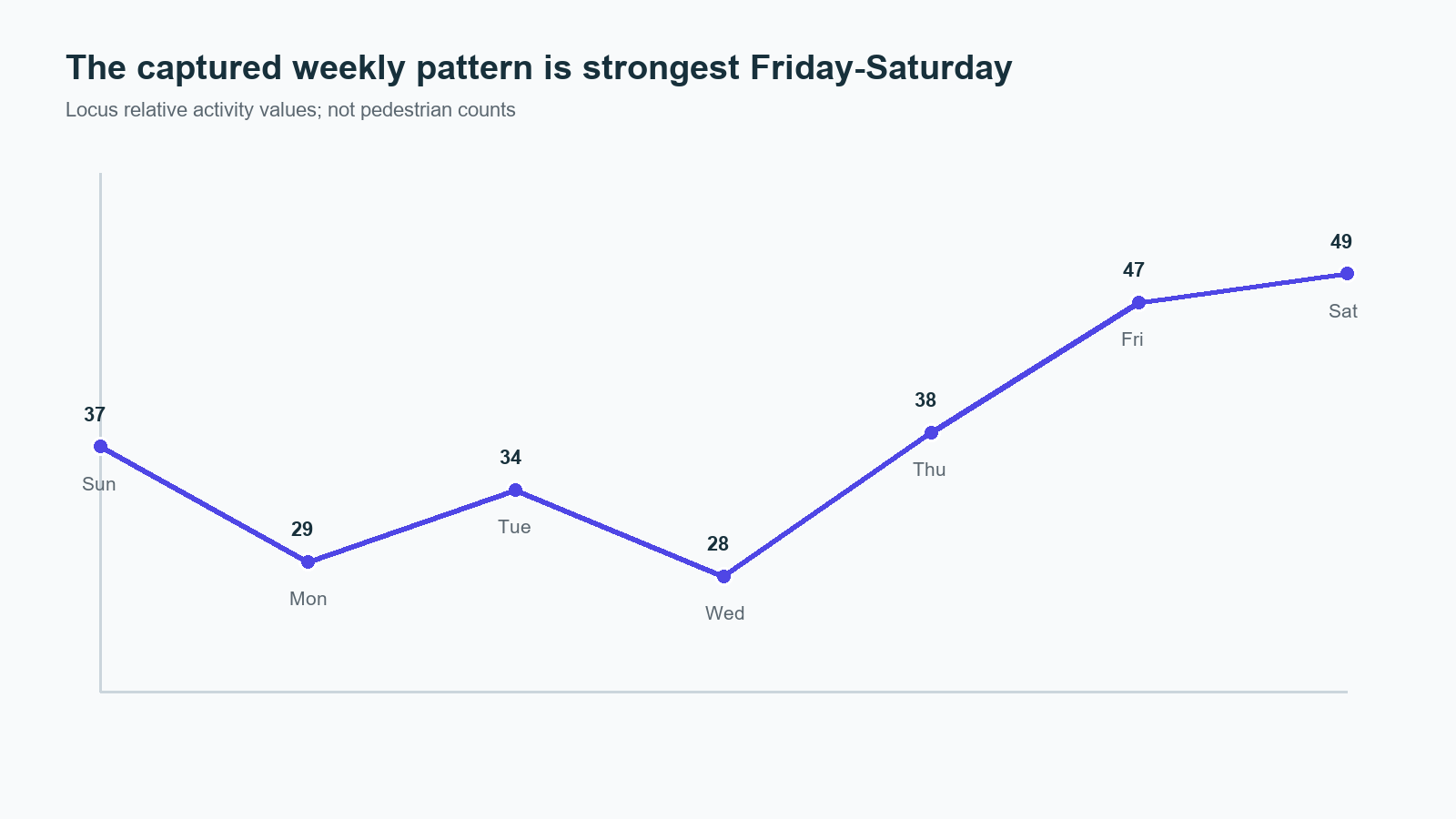
Those signals point to a useful validation brief: measure weekday lunch as well as the reported Friday-to-Saturday strength. The activity index is relative, not a pedestrian count. It does not reveal how many passers-by enter, whether the activity belongs to residents, workers, students or visitors, or whether the pattern reaches a particular unit.
The search figure needs the same discipline. Locus identifies it with the broad keyword “restaurant in Austin.” The screen does not supply the period of growth or prove that the demand is for fast-casual food in this exact catchment. It is a reason to test the concept, not a reason to underwrite sales.
Competition is the constraint that changes the decision
The broad result layer reported 36 businesses, but the direct-competitor view narrowed that to 16 at an average rating of 4.2. The equal-share indication was 9,393 people per direct competitor: 150,291 divided by 16. That is a simple equal-capture indication, not measured market share.
The direct table showed a strong incumbent set. Velvet Taco led the visible performance ranking at 94/100 with a 4.7 rating, 3,133 reviews, 261 reviews per month and an 85% five-star share at 37 metres. Several Raising Cane’s and P. Terry’s locations appeared with scores around 89, while smaller operators such as Buns Out Burgers & wings and Shako Mako Halal showed different combinations of rating, review depth and access.
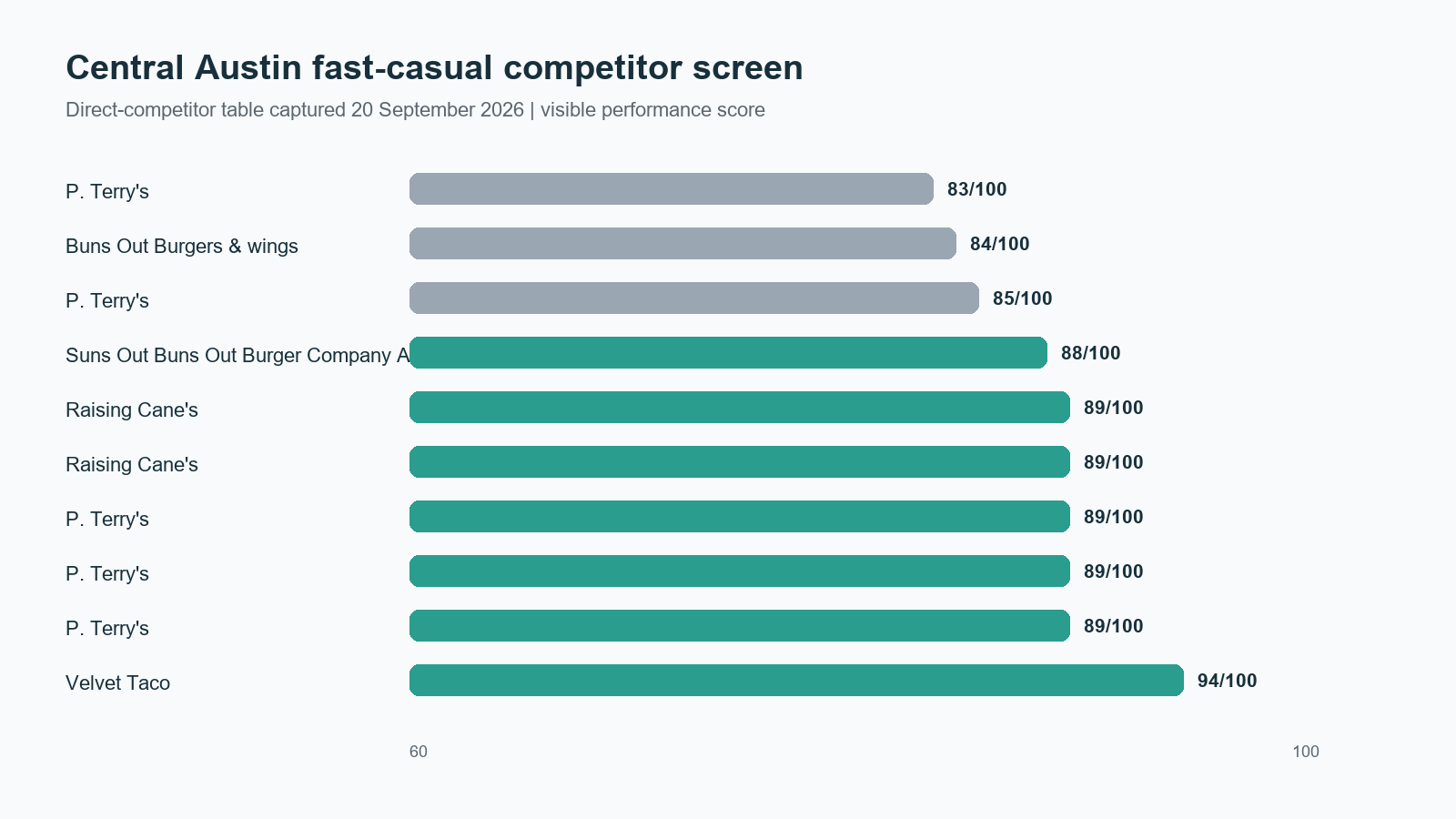
This is more useful than a single competitor count because it shows the type of problem an entrant would face. Some incumbents have scale and review velocity. Others have high ratings but a much smaller review base. The entrant therefore needs a clear advantage in cuisine, speed, value, occasion or convenience; “another restaurant in a busy area” is not a strategy.
There is also a data-quality warning. The broader screen included hotels, retailers, a library, a garage, an arena and the Texas Capitol, and the assessment noted that some leading entries had missing or zero review counts. Before using the 36-business number in a model, rebuild the true fast-casual set and verify opening hours, pricing, waiting times, frontage and customer occasion.
What the 6.9/10 score actually means
The score breakdown was 8/10 for demographics, 8/10 for accessibility, 7/10 for demand, 6/10 for momentum and 5/10 for competition. The assessment labelled the location “Validate first” and described it as a shortlist candidate rather than a final yes.
That is the right interpretation. The Austin catchment has enough evidence to justify unit-level diligence, but the weakest dimension is also the one most likely to decide the economics. A walkable, affluent catchment can still be a poor site if the frontage is hidden, the lunchtime path misses the unit, the concept is undifferentiated or occupancy costs overwhelm achievable sales.
The next validation questions
An operator considering this catchment should:
- Rebuild the competitive set around the actual concept, separating fast-casual restaurants from nearby anchors and destinations.
- Count pedestrians and entries at lunch, dinner and the reported Friday-to-Saturday peaks, with a separate check for weather and events.
- Compare candidate frontages on visibility, safe pedestrian approach, delivery access, parking friction, extraction, use permissions and opening-hour constraints.
- Test whether the proposed price, speed and menu solve a specific gap rather than copying the strongest incumbent.
- Model rent, service charge, labour, fit-out, delivery mix and achievable sales only after the unit and demand observations are real.
The practical conclusion is deliberately narrow: central Austin is worth shortlisting for a fast-casual concept, but the case is won or lost at the frontage and in the competitive proposition. The screen tells an operator where to ask better questions. It does not choose the lease.
All analysis was run in Locus, which brings catchment context, demographics, accessibility, competitor mapping and demand signals into one location-decision workflow. Run your own location study free at locusintel.io →
Sources and methodology
- Locus map workflow — authenticated Austin catchment capture, 20 September 2026.
- Competitor discovery and profile metrics — Google Places-backed signals surfaced by Locus; some entries may be incomplete or misclassified and should be checked before commercial use.
- The location score is a screening composite across demographics, accessibility, competition, demand and momentum. It is not a revenue forecast, measured footfall count, market-share estimate or lease recommendation.
Keep reading
Related guides from the Locus library.
AI-Powered Location Intelligence for Local Business Growth
How Locus brings competitor mapping, demographics, foot traffic, catchment analysis, local reputation tracking, and AI recommendations into one practical workflow.
How AI is Revolutionizing Location Intelligence for Businesses
Discover how artificial intelligence is transforming business location decisions. Learn about AI-powered site selection, predictive analytics, and automated insights.